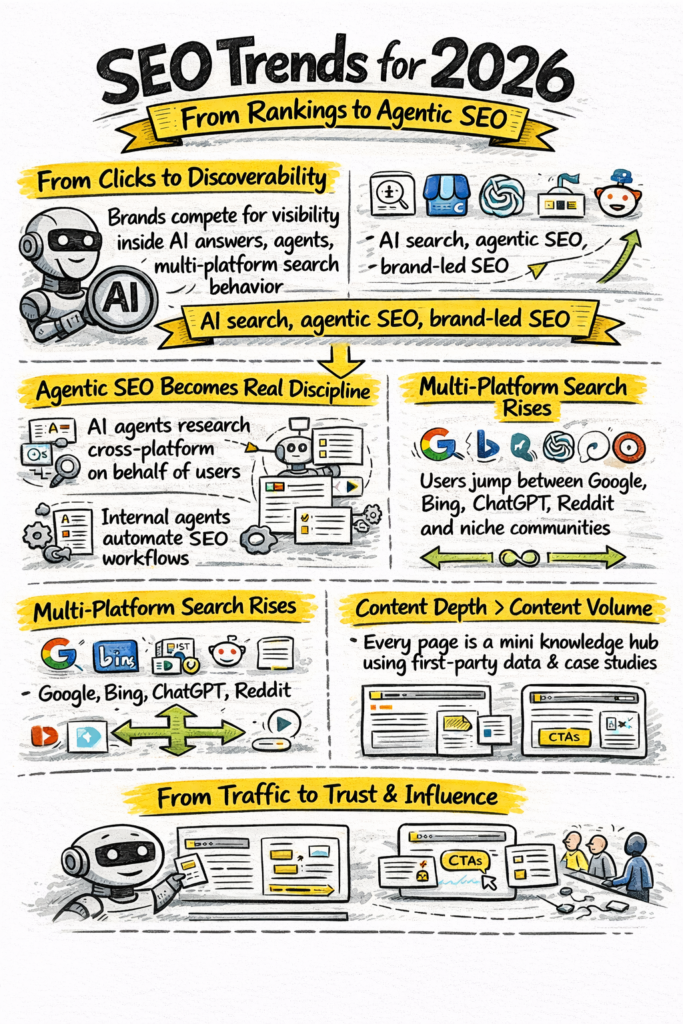
SEO in 2026 moves beyond just rankings and traffic into a world where brands compete for visibility inside AI answers, agent workflows and multi‑platform search behavior.
On the last SEOTalk Spaces for 2025, we interacted with the community to get their insights on possible trends for 2026 – what should we learn and unlearn, to be ready for growth.
Table Of Contents
- What Happened In 2025
- Key SEO Trends For 2026
- Trend #1: Agentic SEO Becomes A Real Discipline
- Trend #2: Brand‑First SEO And AI Discovery
- Trend #3: Multi‑Platform Search And Bing’s Rising Role
- Trend #4: Content Volume, Depth And First‑Party Data
- Trend #5: Designing For Humans And AI Agents Together
- How SEO Teams Should Adapt In 2026
What Happened In 2025
Parth initiated the conversation giving his perspective on what happened in 2025 – most non‑navigational queries, clicks and rankings started losing their central role as AI systems answered more questions without sending traffic back to websites. 2024 was described as the year when organic clicks peaked, with 2026 could become a phase where SEO success is defined by recall, references and brand presence across platforms.
Malhar shared that SEO is shifting “from traffic acquisition to influence and presence”, where being trusted and cited inside synthetic AI answers matters more than just being in the top blue links. Isha also adds that SEOs must “start thinking beyond clicks” because customer behavior and the number of search platforms have both changed, making measurement far more complex than before.
Key SEO Trends For 2026
Trend #1: Agentic SEO Becomes A Real Discipline
Agentic SEO is used in two powerful ways: as AI agents performing multi‑step research on behalf of users, and as internal agents automating repetitive SEO workflows.
Parth highlights that future prompts will look like multi‑paragraph briefs where LLMs break tasks into sub‑searches across websites, GMB listings, Reddit, and communities, then stitch a single synthesized response.
Isha looks at agentic SEO as “automating your SEO process using different agents”, from content ops to reporting, so human teams can focus on strategy and brand narrative instead of mechanical tasks.
This trend means websites must be structured so both humans and AI agents can easily read, navigate, and act—whether that is following internal links, triggering CTAs, or extracting clean, structured information.
Trend #2: Brand‑First SEO And AI Discovery
Brand becomes the primary SEO moat in 2026 as AI systems learn to identify, trust, and repeatedly cite recognizable entities in their answers. Parth stresses that success is about “being trusted, being referenced, the brand that has a recall” inside AI systems, not just in SERPs.
Isha says she is now “working more from the brand and the brand visibility perspective”, focusing on where the brand can be organically visible like ChatGPT answers, guest articles, communities, and social surfaces—rather than platform‑by‑platform hacks.
Anirudh reinforces this by urging SEOs to “think like a content marketer more than an optimizer”, making every asset build brand plus demand at the same time.
Trend #3: Multi‑Platform Search And Bing’s Rising Role
Search in 2026 is clearly multi‑platform: users jump between Google, Bing, ChatGPT, Perplexity, Reddit, YouTube, and niche communities during a single journey. Vijay notes that “there will be a high demand for Bing SEO” as more users in the US and UK set Bing as default and as ChatGPT leans more on Bing‑powered results in some modes.
Parth and Isha both argue that SEOs should avoid a platform‑first mindset and instead focus on fundamentals that travel well across ecosystems—entities, clean information architecture, reviews, and social proof and then adapt those basics per platform where needed.
This platform‑agnostic foundation is what gives brands resilience when AI models or search UIs change overnight
Trend #4: Content Volume, Depth And First‑Party Data
Content remains the core asset in 2026, but the bar for depth, volume, and originality goes up significantly. Gagan predicts that intent “collapses to nothing” because AI conversations blend informational, navigational, and transactional needs, forcing every page to act like a rich informational hub with a clear value proposition.
He recommends aiming for roughly “70% human and 30% AI” in content production, using AI to assist with structure but relying on human expertise, proprietary data, and real stories to stand out.
Anirudh emphasizes leveraging first‑party data and social proof—reviews, case studies, and internal call transcripts—to create content that AI cannot easily replicate from public web data.
Trend #5: Designing For Humans And AI Agents Together
By 2026, SEOs can no longer optimize only for human readers or only for crawlers; they must design experiences that machines can easily parse while still delighting users. Deepak points out the “huge difference in how a machine interacts with your website and how a human does”, arguing that sites must work well for both.
Parth warns that if agents cannot easily click internal links, understand CTAs, or access content due to heavy client‑side rendering, brands risk disappearing from AI‑mediated journeys.
Isha’s stance is that optimization should always start from the end customer, with technical and AI‑friendliness layered on as non‑negotiable hygiene rather than the main goal.
How SEO Teams Should Adapt In 2026
SEO in 2026 evolves into an execution discipline, where the real edge is in consistent, cross‑channel implementation rather than chasing every new AI ranking trick. Parth expects SEOs to build systems for discoverability across web, social, communities, and AI surfaces instead of “chasing updates on LLMs” in a rat race.
What are your thoughts?