

The way people discover businesses is changing fast. AI no longer relies only on keywords and distance, because it now evaluates context, timing, intent, and real-world relevance to decide what deserves attention.
We delve into this topic with our good old friend – Apurva Bose as part of the SEOTalk Spaces.
Let’s start with the basics.
What the Proximity Internet means
In Apurva’s own words – he describes the “proximity internet” as a discovery layer where location is treated as context, not just a search filter. Search engines and AI systems already know a user’s approximate location, time of day, and behavior patterns, so they can answer with more useful results.
Why “near me” is no longer enough
The conversation explains that users do not always need to type “near me” anymore. AI systems can infer that intent and surface relevant businesses based on the surrounding context, not just the exact query.
Context matters more than distance
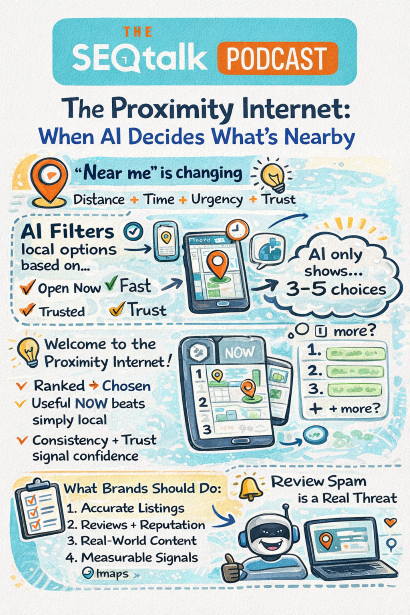
A major theme in the conversation is that “nearby” has become more contextual. For example, someone searching for a plumber at 10 p.m. does not need a random list of results, but a short set of businesses that are open and likely to help immediately.
Mobile search is action-driven
Apurva says mobile search is usually closer to action than research. People on mobile are often ready to call, book, order, or visit within the next 24 to 48 hours.
Discovery is no longer limited to Google
The conversation highlights that proximity-driven discovery happens across maps, smart devices, cars, and even TVs. This means brands need to think beyond classic search rankings and optimize wherever AI-powered discovery can happen.
What brands should optimize
Apurva stresses that businesses should focus on consistency across all digital surfaces. That includes websites, Google Business Profiles, citations, reviews, hours, holiday schedules, photos, and any listing data that AI might read.
Why brand entity matters
A strong brand entity helps AI understand what a business stands for. The conversation shows that it is not enough to repeat keywords, because AI also looks at tone, trust, service quality, and how consistently a brand presents itself across channels.
Reviews still influence discovery
The transcript makes it clear that reviews still matter, but manipulation does not help long term. Apurva warns against fake review tactics and instead recommends responding to negative feedback, resolving issues, and building real trust.
Small businesses can compete
One important takeaway is that small businesses can absolutely benefit from proximity-driven discovery. If their information is accurate and their signals are consistent, they can compete with larger brands in local search.
Why content alone is not enough
The conversation shows that content is only one part of the picture. A business also needs correct location data, helpful operational details, visual updates, and strong reputation signals to improve its chances of being chosen.
The risk of ignoring proximity signals
Businesses that rely only on keyword stuffing or outdated information are at risk. Apurva explains that AI will usually choose the safest and most useful option, which means inaccurate or inconsistent businesses may lose visibility.
The real takeaway for SEO teams
The podcast positions SEO as a trust-building discipline rather than a keyword-only exercise. The best strategy is to keep business information current, useful, and aligned across every platform that feeds discovery systems.
Above all of these, so key insights from Apurva also covered:
AI selects the safest fit
Apurva says AI tends to choose the safest and most relevant option based on the user’s immediate need. That means businesses need to appear trustworthy, current, and useful.
Consistency builds trust
Repeated and consistent information across platforms helps AI systems trust the business more. That consistency is one of the strongest themes in the transcript.
Local businesses have an opportunity
The proximity internet gives smaller businesses a real opportunity to compete. They may not have the biggest budgets, but they can win with better data hygiene and stronger local relevance.
Final Thoughts
The proximity internet is changing how discovery works across search, maps, devices, and local results. Businesses that want to stay visible need to think like AI systems do: prioritize relevance, consistency, context, and trust.
What do you think?
Check out the entire episode below: