
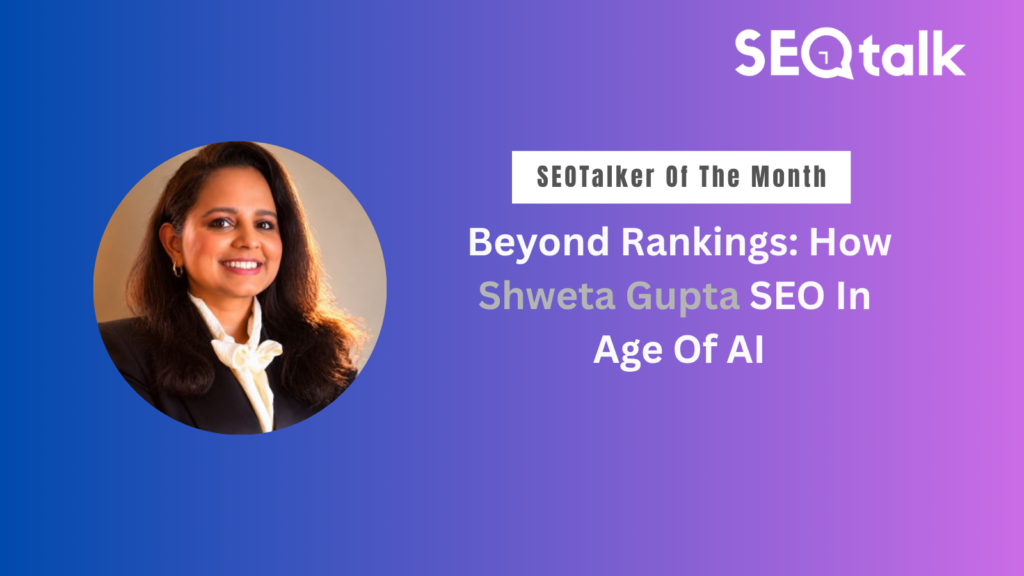
On our Beyond Rankings series, we celebrate the SEOTalkers who are testing, breaking, and rebuilding what works in search.
This month, we spoke with Shweta Gupta — an SEO and content strategist focused on AI-assisted marketing workflows, LLM visibility, and building smarter systems for search. Her answers are honest, practical, and worth reading slowly.
Table Of Contents
- Interview With Shweta Gupta
- Q1. What does your current SEO work look like — role, company type, what you are focused on?
- Q2. What is a win you are most proud of in the last year?
- Q3. One SEO thing you used to believe that you have since changed your mind on?
- Q4. A tool, resource, or habit that has genuinely made your work better recently?
- Q5. One piece of advice you would give a mid-level SEO who wants to get to the next level?
- Our Thoughts
Interview With Shweta Gupta
Q1. What does your current SEO work look like — role, company type, what you are focused on?
Hi, I am Shweta Gupta. My current SEO work sits at the intersection of SEO, content strategy, and AI-assisted marketing workflows.
I am focused on understanding how search is changing — especially with AI search, LLM visibility, and new content workflows. A big part of my role is learning, testing, and applying AI frameworks in my day-to-day SEO and content work, rather than just using AI for quick execution.
For me, SEO today is not only about keywords or rankings. It is about understanding user intent, building useful content, improving visibility across search and AI platforms, and creating systems that help deliver better results more efficiently.
And honestly, I am still learning every day. The pace is fast, but that is also what makes it exciting. My focus right now is to keep adapting, keep experimenting, and use AI in a way that supports better strategy — not replaces human thinking.
Q2. What is a win you are most proud of in the last year?
One win I am genuinely proud of from last year is how much I have learned and applied in AI-assisted SEO and content workflows.
I recently learnt Content Engineering from AirOps, a platform built for marketers. And honestly, it was a big moment for me. Tasks that previously took me 15 to 20 days — including deep research, competitor analysis, market understanding, content planning, and execution across different tools — could now be structured into a workflow and completed in around 10 to 15 minutes. That did not just feel like a productivity win. It helped me see how AI can solve bigger marketing problems when it is used properly.
I am also proud to have been part of a project where we built an AI tool for a client. The tool researches the brand, product, market, competitors, and audience pain points. It then finds content opportunities across platforms like Reddit, Medium, LinkedIn, and Quora, and creates ready-to-post content aligned with the brand’s knowledge base, platform guidelines, and subject matter expert tone.
There was a lot of thinking and testing behind it. But the bigger breakthrough was this: we were not just creating content faster. We were solving a real problem around how brands can appear in LLM-generated answers and build visibility beyond traditional search.
Alongside that, I have also started creating small apps and tools for my own SEO tasks, which has made my day-to-day work more structured and efficient.
My biggest win has been learning that AI makes execution easier — but the real value still comes from strategy, context, and human judgement. That is the part I am most excited to keep building on.
Q3. One SEO thing you used to believe that you have since changed your mind on?
One SEO belief I have changed my mind on is the idea that AI will take our jobs.
At first, honestly, I did worry about it. There was so much noise around AI replacing content writers, SEO professionals, and marketers that it was hard not to question where the industry was going.
But the more I learned and experimented, the more I realised that AI is not replacing us. It is changing the way we work.
AI gives us more space to test, experiment, execute, and practise new things faster. It can help with research, content structures, workflows, analysis, and repetitive tasks. But it still needs human direction, strategy, context, and judgement.
So now I believe AI will not replace SEO professionals. But SEO professionals who are not willing to learn, adapt, and keep up with the pace may struggle.
AI makes execution easier. But smarter people who know how to use it thoughtfully are here to stay.
Q4. A tool, resource, or habit that has genuinely made your work better recently?
Recently, I have been making a conscious effort to practise with new tools and technologies in the market — especially around AI, SEO, and content workflows.
A few tools have genuinely made my work better. I have been learning Claude Code and Codex, and using them to create small apps, AI agents, and workflow tools for my own SEO tasks. That has helped me understand AI beyond just prompting. It has pushed me to think more about systems, inputs, outputs, and how to make repetitive work more efficient.
AirOps has also been a big one for me — a really useful platform for testing workflows around research, competitor analysis, and content creation at scale.
I have also explored tools like Optimizely for AI agents, Meta Monster, AI Visibility Labs, Otterly.ai, and Profound — to understand how brands can track and improve their visibility in AI search.
But more than any one specific tool, the habit that has helped me most is regular experimentation. I try things, break things, rebuild them, and then see what actually improves my work. Not every tool becomes part of my daily workflow — but every tool teaches me something about where SEO and content are heading.
Q5. One piece of advice you would give a mid-level SEO who wants to get to the next level?
Keep experimenting — especially with AI.
Do not hesitate to learn from juniors, peers, or people who are new to the industry. Fresh ideas often come from conversations with people who see things differently.
SEO is changing quickly, so it is important to unlearn what no longer works and relearn what the industry needs now. Stay curious, test new things, and keep adapting.
Our Thoughts
Shweta’s answers reflect something we hear more and more from practitioners who are genuinely ahead of the curve: the value of SEO is not disappearing – it is moving up the stack.
The people who are thriving are not the ones using AI to do more of the same faster. They are the ones using it to think differently — about how brands get cited in AI answers, how content workflows can be rebuilt from scratch, and what it actually means to be useful in a world where LLMs are answering questions before a user ever visits your site.
Shweta’s point about execution versus strategy is one every SEO team should have on their wall: AI makes execution easier, but the real value still comes from human judgement.
That is not a comforting cliché. It is the actual competitive advantage right now.
Beyond Rankings is SEOTalk’s monthly series celebrating the practitioners shaping modern search.
Know someone we should feature? Join us every Monday on X Spaces – @TheSEOTalkers