
Every week, SEO professionals are having the same difficult conversation with their clients.
Traffic is down. The client is worried. And before anyone has looked at the data, “AI” gets the blame.
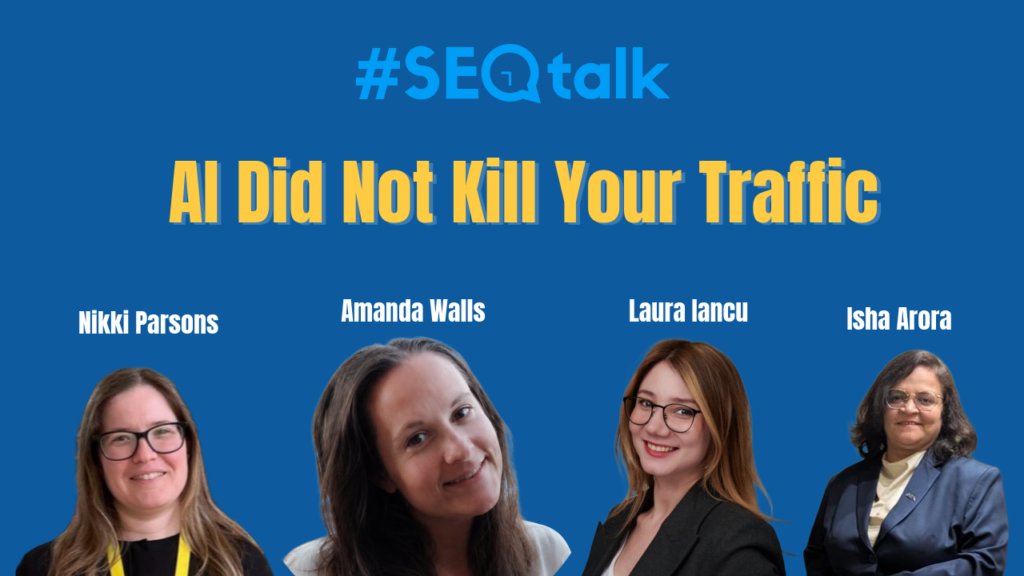
We talked about this directly in our recent Women of SEO webinar. Three experienced practitioners — Amanda, Nikki, and Laura joined our host Isha and shared what they are actually seeing with real clients. And the honest answer was not the one most people expect.
Most of the traffic drops happening right now are not caused by AI.
They are caused by things we could have fixed earlier — and in some cases, things that were always going to happen.
Table Of Contents
Why does this matter?
If you work in SEO, content, or digital marketing, you are probably hearing this a lot right now:
“Our traffic dropped. Is it because of AI Overviews?”
It is an easy answer to give. AI Overviews are new, they are visible, and everyone is talking about them. But easy answers are not always the right ones. And if your client or your team makes decisions based on the wrong diagnosis, you will spend time and money fixing the wrong problem.
What the SEO community is actually seeing
Amanda: “We were losing featured snippets, not traffic to AI”
Amanda Walls is the founder of Cedarwood Digital, an award-winning UK agency. Her team works with a lot of clients in regulated industries, where traffic data is watched closely.
When clients come to her saying AI has destroyed their SEO performance, her team does an audit. And the audit usually tells a different story.
“One thing that we have really noticed is that we are hurting more from the loss of featured snippets than from the AI Overview specifically. When the Overviews came in, they replaced a lot of the featured snippets that we previously had and held at position one.”
In plain English: many sites had been sitting at the top of Google results by holding a featured snippet — the box of text Google shows above the normal results. When AI Overviews arrived, they replaced those snippets. The traffic that came from those snippets disappeared.
The client sees this as AI taking their traffic. But the real story is that they were dependent on one type of SERP feature, and that feature is gone. Those are two very different problems with two very different solutions.
Nikki: “Traffic going down does not always mean revenue going down”
Nikki is a marketing strategist who has worked with global brands including Semrush. She works freelance and speaks to a wide range of businesses.
Her first question when a client says traffic is down is not “what did AI do?” It is: “Have your sales dropped?”
“Traffic is turning into a proxy metric where it is no longer as relevant as it used to be,” she explained. “If you are seeing the revenue and seeing an increase in the number of customers, then you are okay. Do not panic.”
If sales are also down, her starting point is a basic site audit — not an AI investigation. Duplicate pages. Broken site structure. A competitor who has started investing more in the same space.
“A lot of people use AI as a scapegoat,” she said. “Not just in SEO, but in business in general.”
Laura: “Run the boring checks before you blame AI”
Laura is the founder of Searchpedia and works as an SEO consultant for major UK brands.
Her approach when traffic drops is to slow down and check the simple things first.
“AI Overviews are never going to be responsible for a 30 to 40 percent sitewide traffic drop,” she said. “There are so many other culprits before you get to AI.”
Her checklist before any conversation about AI:
- Check Google Analytics segmentation — is the drop sitewide or on specific pages or channels?
- Look at source and medium breakdown — which traffic sources changed?
- Check if cookie consent settings have changed and are now blocking tracking
- Verify that Google Tag Manager is firing correctly
- Look at log files if you can — what is actually being crawled?
“Do three, four, five easy checks first,” she said. “Then share what you find with the wider team — rather than immediately blaming AI.”
The number everyone is sharing — and what it actually means
You may have seen this statistic recently: organic click-through rate drops by around 61% when an AI Overview appears on a search result.
That number is real. But it is measuring something specific: what happens to clicks on that one query when an AI Overview is triggered. It does not tell you how many of your queries are affected, what type of queries those are, or whether the people clicking through were ever going to buy something.
This is important. Not all traffic is equal.
Amanda made this point clearly: “I would argue that 95% of informational traffic does not go any further. It does not go on to make a lead. It does not go on to buy a product. It could be a student doing research. It could be someone just browsing.”
For the last few years, many SEO strategies have involved creating large amounts of informational content — blog posts, guides, FAQs — to pull in top-of-funnel visitors. Some of that content is genuinely useful. A lot of it exists just to generate traffic numbers.
If AI Overviews are now answering those informational questions directly, the traffic that came from them will go down. But if that traffic was never converting, the business impact may be much smaller than the numbers suggest.
As Amanda put it: “Are we blaming AI for this drop — or is it the fact that the content is not relevant anymore?”
The SEOTalk view: 4 things are driving most traffic drops, not one
When we look at what is actually happening across the industry, we think the traffic story has four main causes. AI Overviews are one of them — but probably not the first or the biggest.
1. Featured snippet dependency
Many sites built traffic on featured snippets without realising it. Those snippets are now being absorbed into AI Overviews. The traffic loss is real, but the cause is SERP feature change — not a failure of SEO strategy as a whole.
2. Informational content that was overproduced
The SEO industry created enormous amounts of informational content over the last five years. Some sites have blog posts and guides for products they do not even sell. AI Overviews handle a lot of this type of content efficiently. Losing that traffic hurts the numbers, but often not the business.
3. Ongoing algorithm updates
Google has been updating its algorithms frequently and consistently — helpful content updates, spam updates, quality reviews. These updates have reduced rankings for many sites that had thin or low-quality content. This is happening at the same time as AI, which makes it easy to confuse the two.
4. Measurement gaps
GA4 is not always configured correctly. Cookie consent changes have reduced the amount of data that Analytics can collect. Some traffic that “disappeared” was never properly tracked in the first place.
AI Overviews are a real factor. But for most sites in difficulty right now, they are the fourth or fifth reason for the drop — not the first.
What to do when a client says traffic is down
Here are four practical steps to take before any conversation about AI strategy.
Step 1: Check if revenue and leads are also down
If traffic is down but conversions are stable, you may have lost low-intent visitors who were never going to convert. That is a different problem from a broken SEO strategy.
Step 2: Audit your featured snippet history
Go into Google Search Console and look at which queries you held at position one over the last 18 months. Cross-reference with when the traffic started dropping. If position-one rankings disappeared in mid-2024 onwards, check whether those were featured snippets that got replaced by AI Overviews.
Step 3: Segment the traffic drop by query type
Separate your informational queries (“what is,” “how to,” “why does”) from your commercial and transactional queries (“buy,” “best,” specific product searches). If only the informational traffic dropped and your transactional queries are holding, the business impact is likely smaller than the headline numbers suggest. AI Overviews are currently taking informational traffic. They are not, for the most part, taking transactional traffic.
Step 4: Run the technical checks before you run the AI audit
Check Analytics configuration. Check Tag Manager. Check cookie consent. Check for a competitor that started investing more heavily in your space. These are boring checks — but they are almost always where the real answer is.
The question worth debating
AI Overviews took a large portion of informational traffic across the industry. For many sites, conversions barely moved.
Does that mean we have been building the wrong type of content for years — and AI just made us notice?
We think this is one of the most important questions in SEO right now. And we do not think the industry has been honest enough about the answer.
Tell us what you think in the comments below. Or bring the conversation to SEOTalk Spaces, every Monday on X.
FAQ
Is AI really causing organic traffic to drop?
AI Overviews do reduce clicks on informational queries. Studies show click-through rates drop significantly when an AI Overview appears. However, for most websites, the bigger causes of traffic drops are the loss of featured snippets, thin content being penalised by algorithm updates, and measurement changes — not AI directly.
How do I know if AI Overviews are hurting my website?
Check which queries triggered featured snippets in your Google Search Console history. If those same queries now show AI Overviews and your traffic on those queries dropped, that is a sign of SERP feature change. If your site has broader traffic losses across all query types, the cause is likely something else.
What should I do if my client blames AI for a traffic drop?
Start with the basics: check revenue and leads first, segment traffic by query intent, audit for featured snippet loss, and run technical checks (Analytics configuration, Tag Manager, cookie consent). Build the diagnosis from data — not from the assumption that AI is responsible.
Is SEO still worth investing in if AI is taking clicks?
Yes. AI Overviews primarily affect informational queries. Transactional and commercial queries — the ones that drive revenue — are largely unaffected for now. Brand visibility, entity authority, and quality content remain the foundation of long-term search performance.
What type of traffic is AI Overviews taking?
Mostly informational traffic — searches where someone is looking for an explanation, a definition, or general guidance. AI Overviews answer these efficiently. Commercial and transactional traffic, where someone is ready to buy or compare products, is still largely driven by traditional organic and paid results.
This post is drawn from our Women of SEO webinar series. Check out the episode below: