
As all of in the industry know, Google recently came out with it’s first-ever playbook on AI Search.
We indeed expected the playbook to generate a lot of chatter and it did. Everyone kind of has an opinion about it – someone saying ‘Look, we were saying the same things’ to ‘Google has gone bonkers, they don’t even mean what they say’.
For arguments sake, let’s say we are neutral and taking this playbook at facevalue. In this post, we try to decode in a simple way, what it actually mean and this is totally our understanding.
What we believe is, the new Google playbook explains how to make your site visible in AI Overviews, AI Mode, and other generative AI features, without chasing “AI hacks.”
What Google’s AI Optimization Playbook Says
1. SEO Still Matters In An AI-First Search World
Google clearly states that classic SEO best practices remain the foundation for visibility in AI Overviews and AI Mode because these features are built on the same core ranking and quality systems as normal Search.
Two important techniques behind AI features:
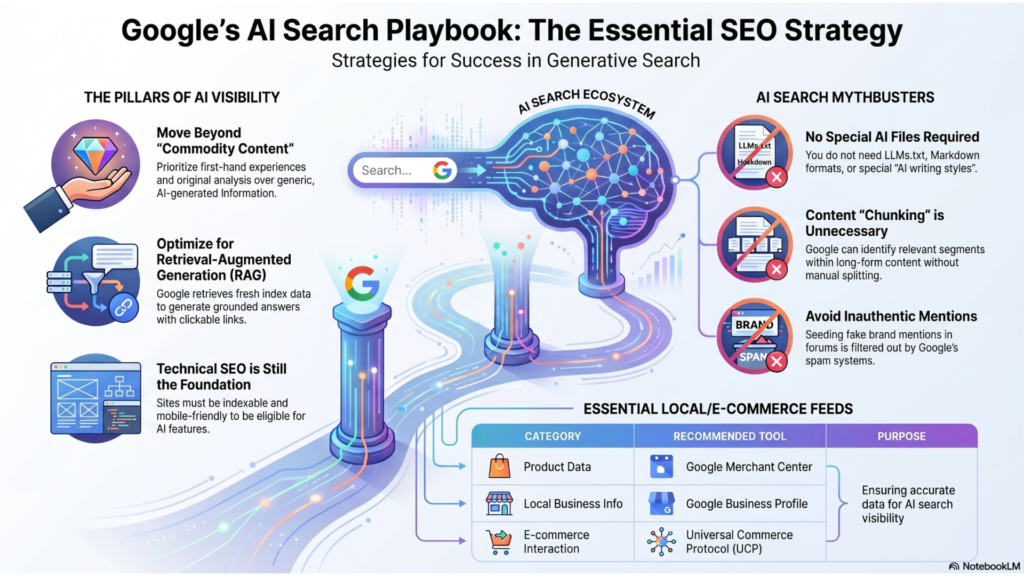
- Retrieval-Augmented Generation (RAG): Google’s AI retrieves relevant, fresh pages from the Search index, then uses those pages to generate a grounded answer and show prominent, clickable links
Query fan-out (Something we talked about on SEOTalk a while ago): For one query, the system fires multiple related sub-queries (like “best herbicides for lawns” or “remove weeds without chemicals” for a lawn weeds query) to find more complete and diverse information.
2. Content Strategy – Non‑Commodity, People‑First Content
The playbook is very blunt: “commodity content” will not help you in generative AI search.
What they really want:
- Unique point of view
First‑hand reviews, real experience, expert opinions, case studies, and original analysis.
Example from the guide: a deep personal story about waiving a home inspection is more valuable than generic “7 tips for first-time homebuyers.”
- Non‑commodity, helpful, reliable, people‑first content
Avoid content that could be written by anyone or easily produced by an AI model from common web knowledge.
Add details only you can provide: data, process, failures, decisions, trade‑offs.
- Good structure for humans
Use headings, short sections, and clear organization so people can scan and understand easily.
This also helps AI systems identify the right part of a page to reference.
- High‑quality images and video
Add relevant images and videos where they help users; these can also surface in AI experiences, not just traditional blue links.
- Avoid query‑spam and scaled content abuse
- Do not create pages for every tiny keyword variation just to manipulate rankings or AI answers; this violates Google’s scaled content abuse policy
3. Technical SEO – Make Your Site Easy For AI To Use
Generative AI features still depend on being able to crawl, index, and understand your site (a very critical element)
Key technical points:
Meet Search technical requirements
Your page must be indexable and eligible to show with a snippet; otherwise it cannot appear in AI features.
Follow crawling best practices
Ensure important pages are not blocked by robots.txt or noindex.
For large / frequently updated sites, manage crawl budget carefully so Google can keep up.
Semantic HTML – “good enough” is fine
Perfect HTML isn’t required; Google can handle messy code.
Still, using semantic tags helps accessibility tools and other systems parse your page better.
Handle JavaScript correctly
Google can process JS content as long as it’s not blocked, but JS SEO is more complex.
Follow standard JavaScript SEO guidelines to ensure content is actually rendered and indexable.
Good page experience
Mobile friendliness, fast loading, clear separation between main content and clutter (ads, popups, etc.).
Reduce duplicate content
Duplicate pages waste crawl resources and confuse both users and search engines.
Use canonicalization and consolidation where possible.
It is important to verify site in GSC to spot technical issues early.
4. Local + Ecommerce – Use Google’s Own Data Feeds
For local businesses and ecommerce, AI responses may show:
Product listings and product info.
Business details like address, hours, and services.
To support this, Google recommends:
Merchant Center / Merchant Center feeds for product data.
Google Business Profile for local business information and presence in Search and Maps.
These sources help AI features show your products and services more accurately and consistently across Google experiences.
5. The AI-Search Mythbusters (Something we all are guilty of saying too)
The playbook explicitly lists things you do not need for AI visibility:
No special AI files like LLMs.txt
- You don’t need custom AI-specific files, text formats, or Markdown to appear in generative AI search
No mandatory “chunking” of content
You do not need to split content into tiny blocks for AI.
Google can understand multiple topics on one page and surface the relevant piece.
No special “AI writing style”
You don’t need to rewrite everything to chase long-tail keywords or specific phrasing.
AI systems understand synonyms and intent, not just exact text matches.
Don’t chase inauthentic “mentions”
Artificially seeding your brand in random blogs/forums is not helpful.
Core ranking systems focus on real quality, and spam systems filter manipulation.
Structured data is useful but not magic
There is no special schema just for generative AI search.
Use structured data for rich results and clarity, but it’s not a direct “AI hack.”
6. Preparing For AI Agents And Browser Agents
The playbook also points to agentic experiences: AI agents that can perform tasks like booking reservations or comparing products on behalf of users.
Important aspects here:
Browser agents may:
Render pages visually (screenshots).
Inspect the DOM.
Use the accessibility tree to understand structure and actions.
Protocols like UCP (Universal Commerce Protocol) are emerging, enabling agents to interact more deeply with ecommerce sites (for example, structured ways to buy, compare, or book).
Next Steps
The playbook closes with four big priorities for site owners:
Apply classic SEO to generative AI search
Technical SEO + unique content remain the foundation.
Create non‑commodity, expert‑driven, people‑first content
Make work AI can reference because it contains insight, not just rephrased web knowledge.
Ignore AEO/GEO “hacks” and focus on durable strategies
No need for chunking tricks, AI-specific files, or fake mentions.
Stay aware of AI agents and evolving protocols
Especially relevant for commerce, bookings, and complex user workflows.
Let us know, based on this guide, what is one concrete change you’d make to your current content strategy so your pages are more likely to be used and cited inside Google’s AI Overviews?