
Agentic commerce is no longer an experimental idea confined to payment companies and technology conferences. The signals are now difficult for commerce brands to ignore.
Adobe’s latest holiday retail analysis found that traffic from generative AI platforms to US retail websites increased by 693.4%, based on more than one trillion visits and 100 million products. Visa reports that 47% of US shoppers already use AI for at least one shopping task, from finding products to comparing prices. Source: Adobe Newsroom
The commercial impact is becoming equally visible. Amazon says its AI shopping assistant has been used by more than 300 million customers and helped generate nearly $12 billion in incremental annualised sales. ChatGPT now supports product discovery through merchant catalogues from retailers including Target, Sephora, Best Buy, The Home Depot and Wayfair, alongside millions of Shopify merchants. Source: Amazon
The shift has also moved beyond recommendations. Mastercard has completed authenticated agent-led transactions in markets including India and Singapore, where AI agents searched, booked and paid using tokenised credentials and verified customer intent. Source: Mastercard
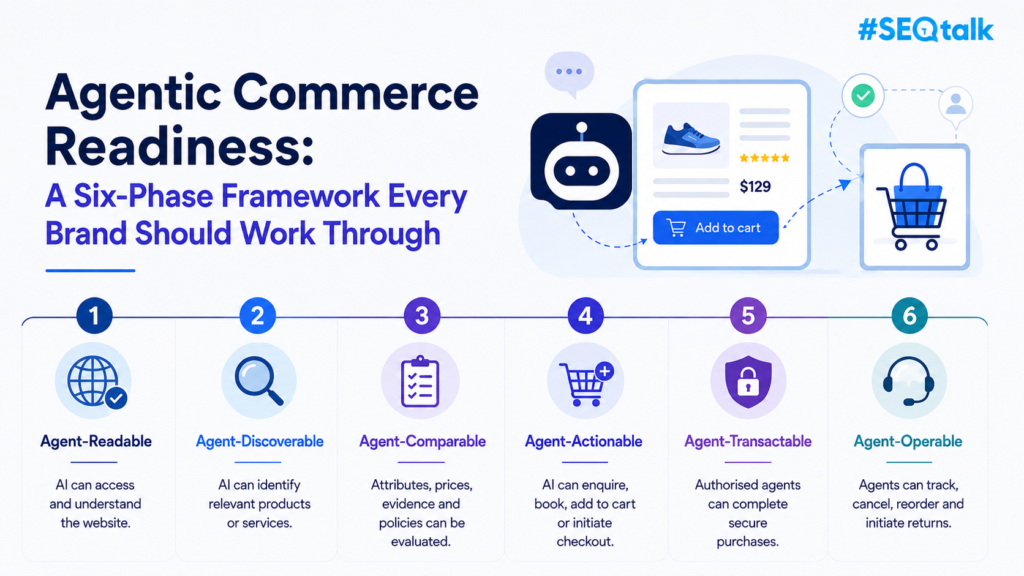
For brands, the priority is not to build an AI shopping agent. It is to make existing commerce infrastructure ready for one. That readiness can be assessed through six phases:
| Phase | Readiness state | What it means |
|---|---|---|
| 1 | Agent-readable | AI can access and understand the website. |
| 2 | Agent-discoverable | AI can identify relevant products or services. |
| 3 | Agent-comparable | Attributes, prices, evidence and policies can be evaluated. |
| 4 | Agent-actionable | AI can enquire, book, add to cart or initiate checkout. |
| 5 | Agent-transactable | Authorised agents can complete secure purchases. |
| 6 | Agent-operable | Agents can track, cancel, reorder and initiate returns. |
Most brands should start with readability, discoverability and comparability. These phases create commercial value today, even when a customer still completes the purchase manually.
Agentic commerce changes the unit of competition
Traditional ecommerce follows a familiar sequence: search, click, browse, compare and buy. Agentic commerce compresses that journey.
A shopper can ask an AI assistant to find a lightweight cabin suitcase under $200, available in black, covered by a five-year warranty and deliverable before Friday. The agent can search retailers, compare specifications, assess reviews, verify stock and recommend the best-matched options. With permission, it can also add the item to a cart or complete the purchase.
The customer may never browse a retailer’s homepage or collection pages. This does not reduce the importance of SEO. It expands the responsibility of search, content, product and ecommerce teams. Brands must now compete for both customer attention and the agent’s confidence.
Phase 1: Make the website agent-readable
Before an agent can recommend a product, it must be able to access and interpret the website. A page may work well for shoppers while remaining difficult for machines when critical information is hidden inside images, loaded only after several JavaScript interactions, blocked by security rules or duplicated across multiple URLs.
What brands should audit:
- robots.txt and AI crawler access
- XML sitemaps and canonical tags
- indexability, duplicate and parameter URLs
- internal links and orphan pages
- JavaScript rendering, page speed and bot-management rules
- accessible product, service and policy information
Phase 2: Make products agent-discoverable
Being crawlable does not make a product discoverable. An agent must understand when the product is relevant to a specific request.
A collection called “The Essential Edit” may appeal to regular customers, but it communicates little to an unfamiliar AI system. “Men’s Lightweight Travel Jackets” defines the product, audience and use case immediately.
What brands should audit:
- product type, category and subcategory
- intended audience and use cases
- materials, dimensions, size and colour
- compatibility or service coverage
- price range and differentiators
- Product, ProductGroup, Offer, Organization, BreadcrumbList, shipping and return structured data
- alignment between visible content, catalogue fields and merchant feeds
Current example: Product discovery inside ChatGPT
ChatGPT now allows users to compare products using price, features, reviews, budget and personal constraints. Through the Agentic Commerce Protocol, merchants can share product feeds and promotions so their catalogues are represented more completely. Retailers including Target, Sephora, Nordstrom, Lowe’s, Best Buy, The Home Depot and Wayfair have integrated for discovery, while Shopify Catalog connects millions of merchants. Source: OpenAI
Product feeds are becoming an AI discovery layer, not merely an advertising asset.
Phase 3: Make products agent-comparable
AI agents evaluate options against customer-defined conditions. A buyer may care about price, material, dimensions, performance, compatibility, warranty, delivery or return eligibility. When these details are missing or expressed through vague marketing language, the agent has little basis for selecting the product.
A “premium backpack for modern professionals” is hard to compare. A “22-litre water-resistant backpack with a padded 16-inch laptop compartment, luggage strap and two-year warranty” gives the agent usable facts.
What brands should audit:
- price and final commercial terms
- specifications, dimensions and materials
- variants and compatibility
- use cases and limitations
- warranty, delivery and returns
- ratings, reviews and certifications
Current example: Amazon’s AI shopping assistant
Amazon’s assistant can compare products, answer detailed questions, check price history, add products to a cart and automatically purchase an item when it reaches a customer’s target price. Amazon reports that customers using the assistant during a shopping journey are more than 60% more likely to purchase. Source: Amazon
Vague descriptions may attract attention. Explicit attributes help an agent justify a recommendation.
Credibility: Give agents evidence beyond the website
Complete product information does not automatically make a brand credible. AI systems can consult several sources before recommending a product. They may compare the brand’s claims with customer reviews, recognised certifications, independent testing, marketplace listings, media coverage, directories and verified business profiles.
For search teams, this broadens the idea of authority. Entity consistency, review quality and factual corroboration become part of commerce readiness, not simply reputation management.
Phase 4: Make the website agent-actionable
An agent-actionable website allows AI to move from recommendation to a valid commercial step. Depending on the business, that may mean selecting a variant, checking stock, adding an item to a cart, booking an appointment, requesting a quotation or submitting an enquiry.
An excellent recommendation is commercially useless when the selected size is unavailable, the delivery promise cannot be confirmed or a discount produces the wrong final price.
What brands should audit:
- variant-level inventory
- current prices and discount rules
- shipping, taxes and delivery estimates
- booking or service availability
- cart, enquiry and quotation functions
- clear machine-readable error responses
Current example: Amazon Shop Direct and Buy for Me
Amazon’s Shop Direct includes more than 100 million products from over 400,000 external merchants. Customers can visit the merchant website or, for eligible products, ask Amazon’s Buy for Me agent to complete the purchase. Merchants can connect catalogues through product-feed providers such as Feedonomics, Salsify and CEDCommerce. Source: Amazon Shop Direct
Discovery depends on complete product data. Action depends on current operational data.
Phase 5: Make checkout agent-transactable
An agent-transactable website allows an authorised AI system to complete a purchase. This requires more than an accessible payment button. The system must establish who authorised the purchase, what the agent may buy, the spending limit, the permitted payment method and whether final confirmation is required.
In 2026, Mastercard completed fully authenticated agentic transactions in India using cards issued by Axis Bank and RBL Bank, payment providers including Cashfree Payments, Juspay, PayU and Razorpay, and merchants including Swiggy, Instamart, Tira, Zepto and Vodafone Idea. The transactions were tokenised and authenticated under Mastercard’s Agent Pay framework.
What brands should audit:
- checkout and order APIs
- guest checkout
- payment tokenisation
- agent authentication and customer consent
- spending limits and fraud controls
- confirmation, receipts, refunds and reconciliation Source: Mastercard
Accountability: Keep the agent visible and governed
As agents gain the ability to act and pay, accountability becomes a core commerce requirement. Customers should be able to understand what the agent was authorised to do, why a product was selected, what information was shared and how the decision can be cancelled or disputed.
Accountability is what separates a trusted commerce agent from an unidentified bot using customer credentials.
Phase 6: Make commerce agent-operable
The commercial relationship continues after payment. An agent-operable business allows authorised systems to track orders, change delivery details, cancel eligible purchases, initiate returns, monitor refunds, retrieve invoices, manage subscriptions and reorder products.
A business is not fully agent-ready when an agent can place an order but cannot correct or reverse it.
What brands should audit:
- reliable order identifiers and status
- cancellation eligibility
- return windows and structured return reasons
- refund status
- support escalation
- reorder and subscription functions
These six phases are not separate technology projects. Together, they describe how a commerce brand must evolve from being visible to AI systems to supporting secure, accountable and complete agent-led customer journeys.
What brands should measure
- Percentage of products with complete mandatory attributes
- Product-feed freshness and price mismatch rate
- Variant-level inventory mismatch rate
- Structured data validity
- Accuracy of AI-generated product information
- Share of relevant prompts producing correct brand recommendations
- Agent-assisted actions, failures and successful reversals
The real starting point
Agentic commerce is often presented as a payments innovation. For most brands, it begins much earlier, with product information and operational clarity.
Before an agent can buy from a business, it must be able to access the website, understand the catalogue, identify the right product, compare it with alternatives, verify the evidence, confirm availability and take an approved action.
The brands best positioned for this shift may not be those with the largest AI budgets. They are more likely to be those with the cleanest data, clearest policies and most dependable commerce systems.
The question is no longer only, “Can customers find and buy from us?” It is also, “Can an AI agent understand why, when and how it should choose us?”
This was a guest post by Isha Mehendiratta for TheSEOTalkers.
Author is the Founding Director of Fixate Private Limited and a Search, Ecommerce and AI Discovery Strategist with over 17 years of experience in SEO and digital growth. She works with founder-led ecommerce and B2B brands to improve visibility across Google, AI search, content and emerging shopping platforms, with a particular focus on product discovery, catalogue intelligence and conversion-led organic growth.
She is also closely involved with Pune Search Labs and the Pune Digital Marketing Community, where she contributes to practitioner-led conversations around search, AI and the future of digital commerce.
Connect with her on LinkedIn, Instagram and X, or visit ishamehendiratta.com.
Interested to write for us, contact us today!