
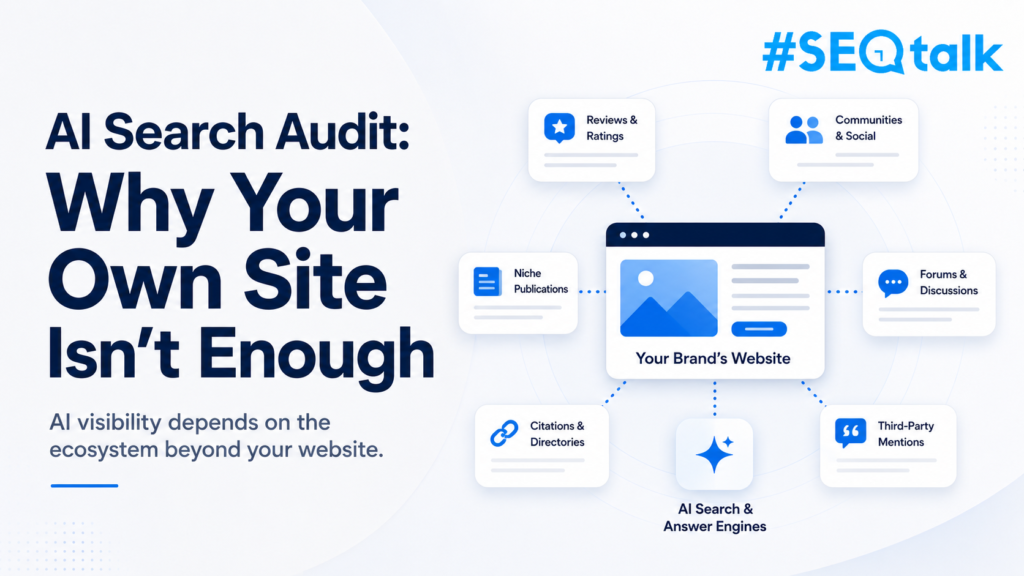
A traditional SEO audit has a clear boundary. You pull the site, check technical health, review on-page elements, analyse backlinks, and produce a report. The website is the unit of analysis. Everything else is context.
An AI search audit does not work that way. When an LLM generates a response about your brand, it is not reading your website alone. It is drawing from reviews on third-party platforms, mentions in niche publications, Reddit threads, YouTube videos, industry directories, and any other surface where your brand has a traceable presence. If your audit stops at your own domain, you are auditing a fraction of what actually shapes how AI systems represent you.
That was the central thread of this SEOTalk Spaces session, and it has direct consequences for how practitioners approach both auditing and client conversations.
Key takeaways
- An AI search audit covers five areas: technical structure, content clarity, indexing status, third-party presence, and off-site narrative consistency
- AI agents crawl pages differently from Google, including canonical and filtered pages that SEOs typically block from traditional crawlers
- A website with indexing issues can still appear in AI search results, traditional SEO eligibility and AI visibility are not the same thing
- Attribution for AI search impact remains unsolved; branded search volume and direct traffic are the most reliable proxies for now
- Owning your brand-plus-review domain and maintaining accurate third-party listings is now a core audit action, not an optional extra
What AI Agents Actually Look At
Panel member Isha opened with an observation from her own client work that challenged a widely held assumption: a website that is struggling with indexing on Google can still show up clearly in AI search results.
Her team encountered exactly this. A site with recurring indexing issues, pages being indexed and de-indexed irregularly, was nonetheless appearing in AI-generated responses. The reason: AI agents do not rely solely on what Google has indexed. They evaluate the full link infrastructure of a site, including canonical pages and filtered product pages that SEOs typically tell crawlers to ignore.
This matters for how you structure an audit. Technical SEO fundamentals still apply, site architecture needs to be sound, content needs to be structured clearly. But the eligibility criteria for AI visibility and the eligibility criteria for Google indexing are not the same thing. An audit that treats them as identical will miss meaningful gaps in both directions.
Watch out
Do not assume that fixing your Google indexing issues will automatically fix your AI search visibility, or vice versa. The two systems evaluate your content differently. An audit that treats them as identical will produce gaps in both directions.
The Five Areas an AI Search Audit Needs to Cover
Drawing from Isha’s framework and the broader panel discussion, a complete AI search audit covers five distinct areas. Each one can be scored and reported against, the same way a traditional SEO audit assigns scores across technical, on-page, and off-page dimensions.
1. Technical and structural readiness. Is the site architecture clean enough for agents to navigate efficiently? Are key pages accessible without requiring JavaScript interactions that agents cannot execute? Is structured data implemented where it adds clarity: products, FAQs, reviews, organisation details?
2. Content clarity and entity recognition. Does the content clearly describe what the brand does, who it serves, and in what context? AI systems build entity models from what they read. Vague or inconsistent brand descriptions across pages make it harder for those systems to represent the brand accurately in generated responses.
3. Indexing and crawl status. Where do you stand in Google Search Console? Which pages are indexed, which are excluded, and which are oscillating? Cross this against what AI platforms are actually surfacing, because the two do not always align.
4. Third-party presence and representation. This is where most audits currently fall short. What does your brand look like on the platforms AI systems draw from? G2, Trustpilot, relevant sub-Reddit, Quora, LinkedIn, niche industry publications, YouTube. Not just whether you are present, but whether you are accurately and positively represented. A strong third-party presence with inaccurate or negative content is a liability, not an asset.
5. Off-site narrative consistency. Parth raised a point that connects directly to ORM practice: the overall narrative about your brand across the internet needs to be coherent. If your website says one thing and ten Reddit threads say something else, AI systems will reflect the weight of the consensus, not your preferred positioning. Owning your brand-plus-review domain, maintaining accurate listings, and actively participating in the communities where your audience asks questions are all part of managing that narrative.
What to do
Score your brand against all five audit dimensions before your next client meeting. Even a rough assessment of where you stand on third-party presence and off-site narrative consistency will surface gaps most traditional SEO audits miss entirely.
The Attribution Problem Has Not Gone Away
The panel offered the clearest framing of the attribution challenge the panel discussed. Measuring the impact of AI search visibility is, right now, closer to measuring the impact of a billboard than measuring the impact of a paid search campaign.
You can see the hoarding is up. You cannot easily prove how many people walked into your store because of it. Brand recall is happening. Direct search volume may be lifting as a result. But the clean causal line between AI citation and revenue conversion that a CMO wants to see in a slide does not yet exist in any reliable tool.
The practical response, shared by Suresh, is to focus on what you can control and measure directly: rankings for commercial intent keywords, conversion events tied to organic entry points, and branded search volume as a proxy for brand recall over time. These are imperfect proxies for AI search impact, but they are honest ones. Presenting inflated or unverifiable AI visibility metrics to a client does more damage to the relationship than acknowledging the attribution gap openly.
Isha
Measuring AI search impact is like trying to count how many people walked into your store because of a billboard. Brand recall is happening. The clean causal line to revenue does not yet exist in any reliable tool. — Isha | SEOTalk Spaces
The Business Case for Building Your Own Audit Tool
One of the more commercially direct contributions in the session came from a panellist who had just closed a client engagement in under a week from first contact. The differentiating factor: a proprietary AI search audit tool that could be demonstrated during the pitch.
The point generalised beyond any single closing story. Clients now trust tools as much as they trust case studies. Walking into a discovery meeting with a working audit tool that produces data specific to the prospect’s brand, showing where they stand across the five audit dimensions, removes a meaningful blocker in the sales process. It shifts the conversation from “we think we can help” to “here is what we found.”
For consultants and smaller agencies especially, building even a lightweight internal tool around an AI search audit framework is no longer a nice-to-have. It is increasingly a competitive requirement.
Where to Start Tomorrow
If you are running your first AI search audit, the sequence that came out of this session is straightforward.
Start by searching your brand name in ChatGPT, Perplexity, and Google AI Mode, both with and without web search enabled. Note what comes back: is the description accurate, which sources are being cited, and where are competitors appearing in the same responses?
Then audit your third-party presence: G2, Trustpilot, relevant subreddits, LinkedIn company page, YouTube, and any niche directories relevant to your industry. Are you present? Are you accurately represented? Are there negative signals that are likely feeding into AI-generated summaries about your brand?
Finally, check whether your brand-plus-review domain is owned. If someone searches for your brand name alongside the word “review,” where do they land? If you do not own that surface, you do not own the narrative AI systems will use when someone evaluates you.
The audit scope has expanded. The good news is that the skills required to run it, understanding platforms, evaluating brand perception, reading data across multiple tools, are skills most experienced SEOs already have. The framework just needs to be applied in a wider direction.
Frequently asked questions
Q1: Does my website need to be indexed on Google to appear in AI search results?
Not necessarily. AI agents evaluate a site’s full link infrastructure and content independently of what Google has indexed. There are documented cases of sites with recurring indexing issues still appearing in AI-generated responses, because agents crawl and interpret pages differently from traditional search crawlers.
Q2: What third-party platforms matter most for an AI search audit?
The platforms that carry the most weight are those AI systems draw from when forming brand summaries: G2, Trustpilot, Reddit, Quora, LinkedIn, YouTube, and niche industry publications relevant to your category. The key question is not just whether you are listed but whether the information about your brand on those platforms is accurate and consistent with what your own site says.
Q3: How is an AI search audit different from a traditional SEO audit?
A traditional SEO audit focuses primarily on your own website: technical health, on-page elements, backlink profile, and rankings. An AI search audit extends that scope to include how your brand is represented across every surface AI systems use to form their responses, including third-party reviews, UGC platforms, and niche publications. Your website is one input among many, not the only one that matters.
Q4: How do you measure the impact of AI search visibility when attribution is so difficult?
There is no clean attribution tool yet. The most reliable proxies are branded search volume in GSC (a signal of brand recall), direct traffic trends, and conversion events tied to organic entry points. Comparing these against periods of active AI search work gives a directional read, even if the causal line is not precise. Treating it like offline media measurement, estimating rather than exact-matching, is the most honest approach for now
Q5: Should small brands worry about AI search audits, or is this only relevant for larger businesses?
AI search audits are relevant at any scale, but the starting point differs. Larger brands with existing content and review infrastructure need to audit what is already out there and correct inaccuracies. Smaller brands starting from scratch should focus first on building consistent, accurate representation on the key third-party platforms their audience uses, then auditing that presence regularly as it grows. The playbook varies by industry, so understanding which platforms your specific audience and AI systems actually reference in your category is the first step.
SEOTalk Spaces is a weekly community conversation hosted by Malhar Barai. This session featured contributions from Isha, Parth Suba, and community members from the SEOTalk audience.