
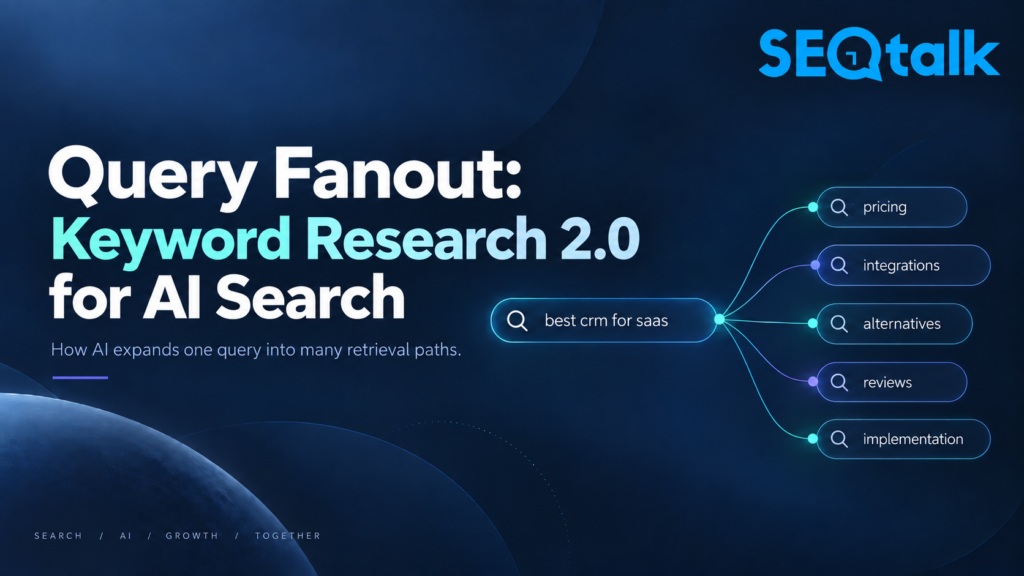
When a user types a detailed prompt into ChatGPT, Perplexity, or Google AI Mode, the system does not simply search for one answer. It fires multiple sub-queries simultaneously, scanning different domains, review platforms, forums, and trusted sources to stitch together a response. This is query fan-out. And if your content strategy is still built around individual keywords and single pages, it is optimising for a search behaviour that no longer exists at the top of the funnel.
Episode 140 of SEOTalk Spaces unpacked what this shift means practically: for how keyword research works, how content should be structured, and what it takes to be retrieved rather than just indexed.
Key takeaways
- Query fan-out is not a new name for keyword research — it is a meaningfully different process that requires a different content strategy
- A single user prompt now triggers multiple sub-searches across different domains simultaneously; one page cannot answer all of them
- Keyword volume is still relevant as a demand signal, but the one keyword one page model is finished
- Your content needs to answer questions across the full customer journey, not just the query that sits closest to your product
- For B2B brands, review platforms like G2 and Gartner are currently the strongest citation sources in AI-generated responses
Keyword Research Is Not Dead. It Just Grew Up.
The panel’s consensus was clear: keyword research has not been replaced, but its role has changed significantly.
Parth put it cleanly. Previously, keyword research meant identifying a specific query, matching it to a page, and optimising for that one demand signal. Now, a single user prompt carries multiple intents simultaneously. The AI system must resolve each of them to build a coherent answer, pulling from different pages, different sites, and different content types in a single pass.
Isha added a dimension that gets missed in most keyword research conversations: the funnel collapse. Where keyword strategy used to sort queries neatly into awareness, consideration, and decision buckets, a single AI-era prompt can span all three at once. Someone asking about the best running shoe for tropical weather under $200 with a wider fit is asking a buying question, a category question, a climate question, and a technical question simultaneously. No single page was ever designed to answer all of that. Query fan-out is what happens when the AI tries to anyway.
What to do
Map your content against the full customer journey, not just the query closest to your product. Identify which sub-questions your brand is not currently answering and treat those gaps as priority content opportunities.
Is Volume Still Relevant?
Malhar asked the question directly: if fan-out is rewriting how queries work, does search volume still mean anything?
Yes, but with an important caveat. Volume remains the fundamental demand signal. It tells you whether a topic has enough interest to justify investment. What has changed is the output of that research. The one keyword one page model is finished. A more accurate model is: one topic cluster, multiple interconnected pages, each addressing a different dimension of the same underlying need.
Parth’s practical framing: the most important question in content strategy is no longer “what is the search volume for this keyword?” It is “what would my customer search before, during, and after they arrive at this content?” Your internal linking structure needs to reflect that journey, not just connect pages for crawlability.
What Actually Gets Cited
The most commercially direct contribution came from a community member at Netcore, raising something many in-house SEOs are quietly dealing with: a brand can be cited as a source in AI responses without being mentioned as a recommendation. Their domain was appearing in citations 80 percent of the time. They were being mentioned as a brand in only 20 percent of those responses.
The diagnosis from the panel: entity authority is still underdeveloped for many brands. It is not enough to write content that ranks. The brand’s story needs to be told consistently across the web, by third parties, not just on the brand’s own site. For B2B specifically, review platforms like G2 and Gartner are consistently the highest-cited source types in AI-generated responses about software products. Organic mentions there carry significantly more weight than self-published listicles.
Watch out
Being cited and being mentioned are not the same thing. If your domain appears in AI source citations but your brand name is absent from the generated response, your entity authority is the gap to close, not your content volume.
Content That Survives Fan-Out
Isha’s practical advice for content that holds up in a fan-out environment was specific enough to act on. Answer the question in the first paragraph, not the last. Include proprietary data or original insight in the first 100 words if possible. Generic content that restates what is already in the AI’s training data will not surface because the model already has that answer. What gets retrieved is what adds a layer the model cannot generate on its own.
The clothing industry example she gave is instructive. A t-shirt brand that publishes generic product content will not be retrieved for styling-related queries. A brand that publishes “how to wear a black t-shirt to the office” content rooted in its own sales data and customer behaviour has a legitimate claim on a query the AI cannot fully answer from its existing knowledge.
The broader principle: query fan-out rewards depth over breadth. Not more content, but content that genuinely adds something to the parts of the topic that are still open questions.
Frequently Asked Questions
What is query fan-out and why does it matter for SEO?
Query fan-out is the process by which an AI search system breaks a single user prompt into multiple sub-queries, scanning different sources simultaneously to build a comprehensive answer. It matters for SEO because no single page can satisfy all the dimensions of a complex prompt. Brands that cover the full topic space across interconnected pages are more likely to be retrieved than those optimising for individual keywords.
Is keyword research still useful in the age of AI search?
Yes, but its role has shifted. Keyword volume remains a valid demand signal. What has changed is the output: the one keyword one page model has been replaced by a topic cluster approach where multiple pages, each addressing a different dimension of user intent, work together and interlink to cover the full query space an AI system might explore.
Why is my brand being cited by AI but not mentioned in the response?
Being cited means the AI system pulled from your domain as a source. Being mentioned means your brand was named in the generated answer. The gap usually signals an entity authority problem: your brand’s story is not consistent or prominent enough across third-party sources for the AI to confidently surface you as a recommendation. Review platforms, forums, and editorial mentions carry more weight than self-published content for closing this gap.
How should content be structured to perform well in query fan-out?
Lead with the answer, not the context. Include original data, proprietary insight, or a specific example in the first 100 words. Ensure your content adds something the AI cannot generate from its existing training data. Generic content that restates widely available information will not be retrieved because the model already has that answer.
Does storytelling still matter if AI just wants snackable answers?
Yes, but in different places. Snackable, directly answerable content performs better on your own pages for AI retrieval. Storytelling matters most in third-party content, where your brand narrative is being communicated by others. The story you tell about your brand needs to be consistent across every surface where others are talking about you, because that is the narrative AI systems aggregate when forming an opinion about your brand.
Check out the episode