
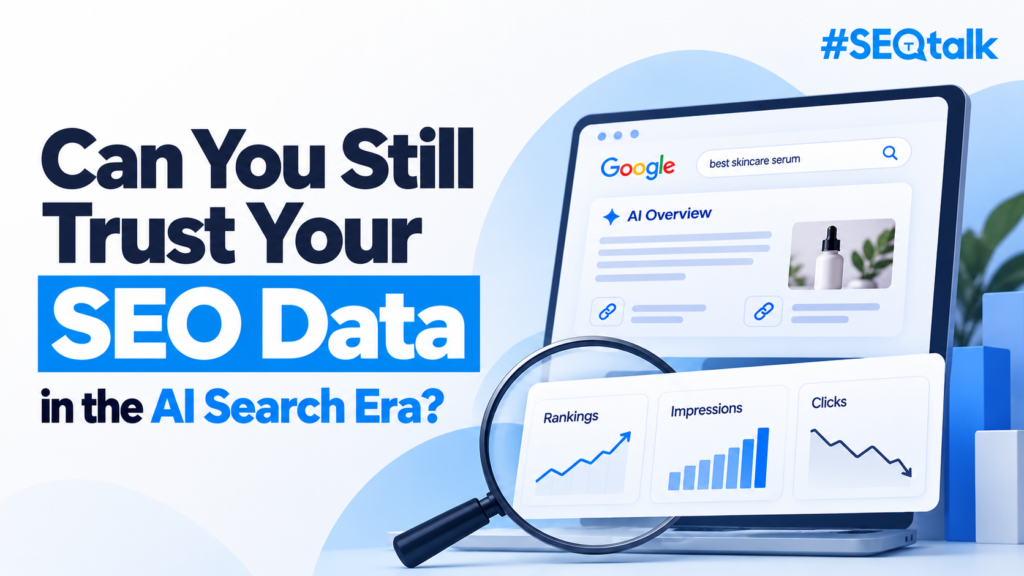
Most SEO dashboards were built for a world where rankings mapped to traffic, and traffic mapped to revenue. That world is dissolving.
Google confirmed earlier that every link inside an AI overview inherits the overview’s position, so a page cited fifth inside an overview at the top of the results reports as position one. Those links do not leave Google. AI overviews now appear in roughly 40 percent of US desktop searches. Rankings are climbing. Traffic is flat or falling. The data is pointing in opposite directions.
Episode 145 of SEOTalk Spaces asked the question that practitioners have been avoiding: can you still trust your SEO data, and if not, which parts are worth keeping?
Key takeaways
- GSC impressions are the most mistrusted metric on the panel – they count results you never scroll to and pages that stay inside Google’s AI ecosystem without generating a click
- Keyword rankings no longer capture where users actually engage with content; AI citations, featured snippets, and AIO links all bypass the traditional click model
- Rank trackers are becoming less reliable as SERPs personalise and Google’s go-to URL changes make third-party scraping harder
- The future SEO dashboard leads with revenue and conversion, adds brand search demand, share of voice for non-brand queries, and AI referral traffic as a separate channel
- A multi-source approach – combining GSC exports, Microsoft Clarity, and a manual 20-question prompt battery – is the most reliable way to triangulate what is actually working
The Metric the Whole Panel Agrees to Distrust: Impressions
Parth opened with the metric he doubts most. Suchi agreed immediately and then Ryan picked it up as well.
The issue with GSC impressions is not that the number is fabricated. It is that the definition of an impression is much looser than most practitioners realise. Google counts an impression whenever a result appears in a search, including results the user never scrolled to. Ryan described it plainly: a page sitting at the bottom of page one, behind an AI overview and three other features, counts as an impression even if the user never saw it.
Ryan’s analogy: imagine driving a highway lined with hundreds of injury lawyer billboards. Each one is an impression. None of them matters until you actually get injured and need a lawyer. The same logic applies to search. An impression buried below the fold, behind an AI answer the user already accepted, is not a brand touchpoint. It is a data point that flatters dashboards without driving business outcomes.
The concern is sharper now that AI overviews dominate informational queries. The user resolves their question inside Google. Your page was cited or visible somewhere in the stack. You received an impression. You received no visitor.
Watch out
Impression counts in GSC can look impressive to a client who does not understand how they are calculated. Presenting a big impression number without context is not just misleading but also it delays the harder conversation about whether the organic channel is delivering business value.
Why Keyword Rankings Are No Longer a Complete Story
Suchi extended the critique to rankings. A brand can hold a position one ranking for a head term and see no meaningful traffic, because the SERP is now a stack of features sitting above that blue link.
The D2C skincare example Parth described is a clean illustration. A brand tracking average position six or seven for category head terms sees a steady, even improving, single-digit ranking. Traffic to product pages stays flat. The ranking metric is technically correct. The business picture it implies is wrong. The improvement in position is being captured by an AI citation in the overview, not a click that converts to a session and a sale.
Suchi drew a distinction that is worth preserving: citations are a different measurement from rankings, and treating them as the same kind of metric produces bad decisions. A ranking reflects where a URL appears in a traditional link stack. A citation reflects whether your content was retrievable enough for an LLM to pull from. These are different signals, they reward different types of content quality, and they should be tracked separately.
For brands still optimising primarily around ranking positions, Parth’s view was direct: traffic will decline quarter over quarter through to 2028 and beyond as AI mode becomes the default interface. The channel needs to be reframed as brand influence and an intermediary touch point, not a direct traffic driver.
Are Rank Trackers Getting Less Accurate?
Parth raised a structural problem the industry is not fully discussing yet. SERPs are becoming more personalised, which means the positions a rank tracker reports are increasingly a simulation of a search experience rather than a true reflection of what any given user sees.
The personalisation problem compounds a technical one. Google’s introduction of go-to URLs, partly in response to competitors like Perplexity scraping search results through SERP APIs, has made third-party rank tracking harder. Some tools have found workarounds. But the direction of travel is toward a search environment that is more hostile to external measurement, not less.
Ryan’s position was more radical. He does not use traditional SEO tools at all. His stack is built on a Claude subscription, free data from sources like GSC and a subset of Ahrefs, and open-source tooling he has published on GitHub. The argument is that AI subscriptions now make it possible to build a custom process from public data that replicates what enterprise tools charge hundreds of dollars a month to provide. The tool, in his framing, is only as good as the professional using it. A practitioner who understands the underlying process does not need to outsource the thinking to a paid platform.
Parth acknowledged the parallel: rank tracking faces the same reliability problem as prompt tracking for AI search. Both depend on sampling a personalised, probabilistic output and treating the result as a stable signal.
What Belongs in a Rebuilt SEO Dashboard
Malhar put the redesign question directly: if you had to delete 50 percent of your current dashboard metrics, what would stay and what would go?
Parth’s version of a rebuilt dashboard has five components.
The first is revenue from organic and visits-to-conversion. Everything else is an input. If organic activity is not connecting to business outcomes, no amount of ranking improvement is worth reporting.
The second is AI referral traffic, tracked as a separate channel. Google Analytics now identifies this natively. It belongs in the dashboard alongside traditional organic traffic, not merged with it, because the attribution model and the optimisation levers are different.
The third is brand search demand: is direct interest in the brand growing month over month? This is a leading indicator of whether brand-building activity, including AI visibility work, is compounding into awareness.
The fourth is share of voice for non-brand category terms across prompts and traditional search. This is the competitive signal. It tells you whether the brand is holding or losing ground in the queries that matter to the category, regardless of which surface those queries resolve on.
The fifth is impressions split by whether those queries trigger AI overviews. The same query, resolved through a traditional blue link versus an AI overview, represents fundamentally different user behaviour and different commercial value. Tracking them together obscures the split.
Isha added a practical note from agency experience. Revenue numbers, even when they are not directly attributable to organic activity, remain the most durable metric for client conversations. When revenue is positive, the conversation stays constructive. When it turns, no amount of ranking improvement will hold the relationship. Building toward indirect attribution, where the client understands that organic visibility is influencing revenue that gets captured through other channels, is the communication work that matters now.
How to Triangulate What Is Actually Working
Ryan described a three-signal method he uses across every property he manages. No single source of data is acted on alone.
The first signal is the GSC performance export. Once a month, he exports all queries from the performance tab, looking for keywords that appeared in impressions or clicks. These form the candidate list of queries worth investigating further.
The second signal is Microsoft Clarity. Clarity shows where users landed from and allows him to draw parallels between queries surfacing on Bing’s AI systems and what is likely happening on Google. When a query shows up in the GSC export and also appears as a referral source in Clarity, the signal strengthens.
The third signal is a 20-question prompt battery, run monthly in a logged-out incognito browser behind a VPN. The battery covers the full consideration journey a real customer would take. For each prompt, he records whether the brand was cited, whether the citation appeared inside an AI overview, and whether it progressed to a recommendation. When all three signals align – the query shows in GSC, the referral shows in Clarity, and the prompt battery confirms a citation or mention. Now he has objective data worth acting on.
Ryan referenced the intelligence analyst’s collection cycle as the mental model: no decision made on a single source, multiple independent signals synthesised into a conclusion before any action is taken.
What to do
Export your GSC performance data monthly. Layer in Clarity referral data. Run a fixed 20-question prompt battery in a logged-out incognito session. Only act on a query when at least two of these three sources point in the same direction.
The Data Regulation Problem Nobody Has Solved Yet
Isha raised a concern that sits underneath all of this. India’s DPDP legislation and equivalent privacy regulations across the EU and US are moving toward a world where individual user tracking becomes legally constrained or prohibited. If analytics tracking becomes opt-in by default, the data foundations that traditional SEO reporting is built on become structurally thinner.
Ryan extended this: GDPR is already tightening in certain US states. The trend is toward more restriction, not less. Practitioners who are already uncertain about the reliability of their data need to plan for a future where there is meaningfully less of it.
The panel did not have a resolution to offer. The point was worth naming: the tools and metrics being debated right now may face a further constraint from regulation that has nothing to do with Google’s product decisions.
Communicating the Gap Between Rankings and Revenue
The hardest practical problem of the session was not measurement. It was communication. How do you explain to a client that rankings are improving while traffic is declining, and that this is not a contradiction but a structural change in how the channel works?
Parth’s framing was direct: tell clients the truth. Visibility went up. The surface where demand gets captured has moved. The revenue connection now runs through a longer path, and the work is to understand and close that gap rather than to pretend the old attribution model still holds.
Ryan’s version was the same thing said differently. He calls it “barney style” – stripping the dashboard down to the metric that connects directly to what the client cares about, which is almost always revenue or foot traffic or leads, and explaining everything else in terms of how it contributes to that number.
The longer-term shift Isha described from her agency practice: she stopped reporting on rankings some time ago. The conversation with clients now covers organic reach holistically, which includes any non-paid activity that contributes to the business, regardless of whether it flows through traditional organic search, AI visibility, content that was published six months ago and is still pulling traffic, or community-driven mentions. The attribution is harder to prove. The client relationship is built on the understanding that the work is building something cumulative rather than delivering a weekly position report.
Join the conversation
Which metric have you quietly stopped trusting in the last six months, and what are you using instead? Has the rankings-going-up, traffic-going-down gap changed how you present results to clients?
Frequently Asked Questions
Is an AIO link the same as an organic click?
No, and the distinction matters for how you report performance. When a user clicks a link inside an AI overview, they are navigating within Google’s ecosystem in most cases. The page may not receive a traditional session in analytics. Even when it does, the user intent and engagement pattern is different from someone who clicked a blue link in a traditional result. AIO exposure is closer to a brand impression than a qualifying visit, and it should be reported and valued accordingly.
Why are rankings going up while traffic is going down?
Because the click no longer follows the ranking the way it used to. AI overviews, featured snippets, and other SERP features resolve the user’s query before they reach the blue links. A brand can hold or improve a ranking position while the feature above it captures the click. The ranking metric is technically accurate. It is just describing a smaller and less commercially valuable portion of the search experience than it did three years ago.
Should I still track keyword rankings at all?
Rankings still have value as a directional signal and a competitive benchmark. They tell you roughly where you sit in the traditional organic stack relative to competitors, and changes in position can indicate algorithmic shifts worth investigating. The problem arises when rankings are treated as the primary output of SEO work, rather than one input among several. Pair ranking data with share of voice across prompts and AI surfaces for a more complete picture.
How do rank trackers handle personalised search results?
Imperfectly, and increasingly so. Most rank trackers simulate a logged-out search from a fixed location and device profile. As Google personalises results more aggressively based on location, device, search history, and now AI mode preferences, the gap between what a tracker reports and what any specific user actually sees grows wider. This is a known limitation, not a bug in the tool. Use rank data as a trend indicator, not as a precise measurement of real user experience.
What is the most reliable free data source for SEO performance right now?
Google Search Console remains the most reliable foundation, despite the impression count limitations discussed in this episode. The query-level data in the performance report, especially filtered by page and country, gives you the closest available proxy for what Google is surfacing from your site. Microsoft Clarity adds referral-level insight that GSC does not provide. Together, combined with a manual prompt battery, these three free or low-cost sources give a more honest picture than a single enterprise tool dashboard.
How do you explain to a client that their SEO is working when traffic is declining?
Start by reframing what “working” means. If your technical SEO and content foundations are sound and the brand is appearing in AI overviews and category-relevant prompts, the channel is functioning correctly in the current environment. What has changed is where demand gets captured, not whether the brand is visible. The conversation shifts from “here is our traffic this month” to “here is where our brand appeared in the consideration journey, and here is the revenue we can connect to organic activity across a longer attribution window.”