
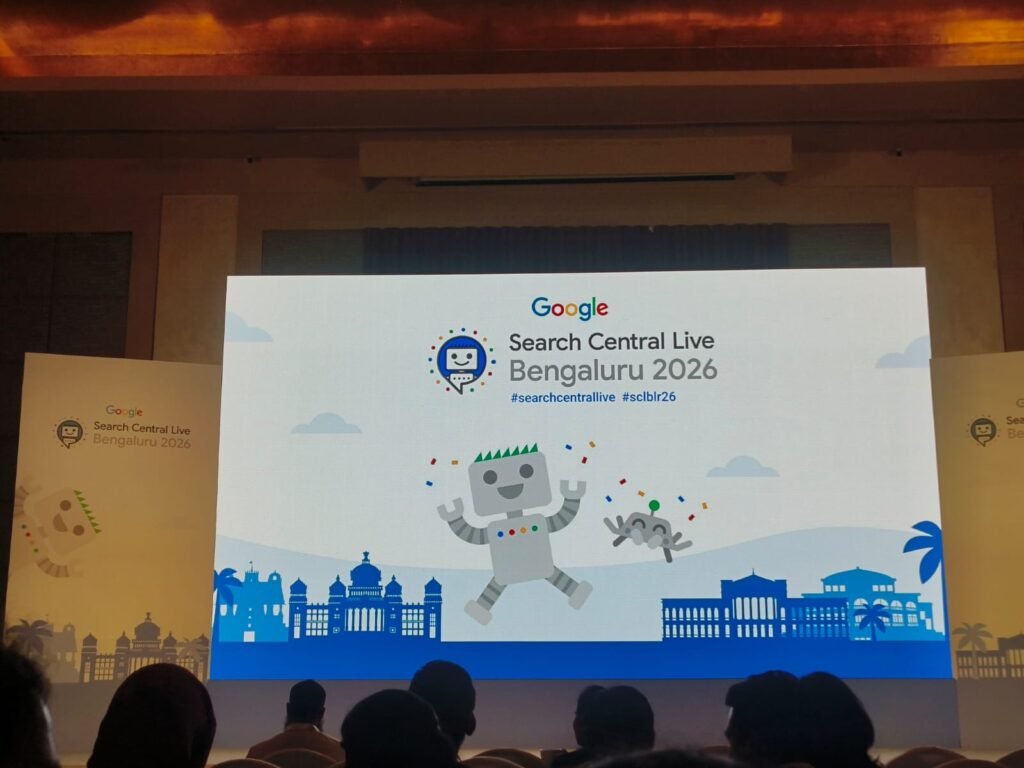
This blog is written by Saranya for TheSEOTalkers Community.
Google Search is evolving. AI Overviews, AI Mode and conversational search are changing how people discover information. But does that mean SEO is dead?
Not at all. SEO is evolving, not disappearing.
That was my biggest takeaway from Google Search Central Live Bengaluru 2026. The event offered valuable insights into Google’s approach to AI-powered search, technical SEO, Google Discover, content quality and changing search behaviour.
Beyond the sessions, connecting with other SEO professionals and exchanging ideas about AI adoption made the experience even more valuable.
Here are my key takeaways.
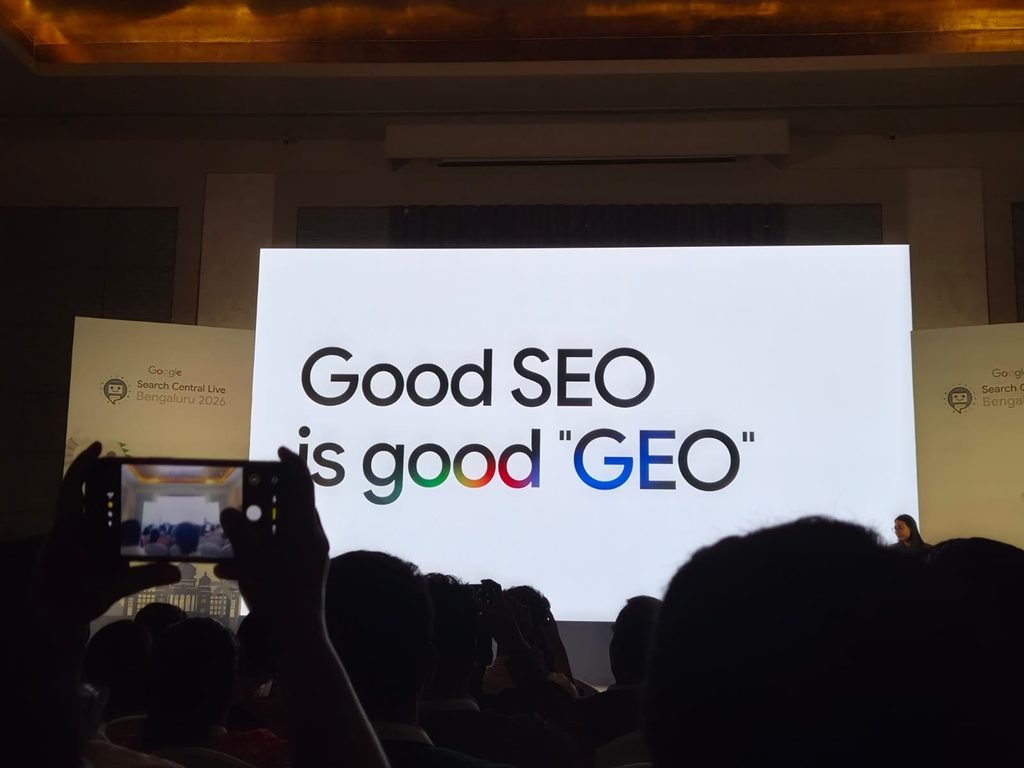
1. SEO is not dead. Good SEO is good GEO.
One message stood out: Good SEO is good GEO (Generative Engine Optimization).
Google’s guidance was clear: there is no secret formula for appearing in AI-generated answers. The fundamentals of traditional SEO continue to matter.
This means:
- Creating useful, original and trustworthy content.
- Making websites easy to crawl and index.
- Maintaining strong internal linking.
- Providing clear content structure.
- Demonstrating real experience and expertise.
Ranking first in Google does not guarantee that your page will be cited in AI answers.
The best approach is still to create content for people first, rather than trying to optimise exclusively for AI systems.
What this means for you
There is no separate optimisation track for AI answers. The same principles that help a page rank in traditional search — crawlability, clear structure, original expertise, trustworthy content — are what help it appear in AI-generated responses. Parallel strategies are not needed. One solid strategy, executed well, covers both.
2. How Google Search works and where AI fits
One of the most technical discussions explained how AI Overviews and AI Mode use the same crawling and indexing infrastructure as traditional Google Search.
An interesting concept was query fan-out, where AI systems break complex questions into multiple related searches to retrieve relevant information.
Other important takeaways included:
- Google’s ranking systems consider relevance, quality, usability, language, location, freshness and spam signals.
- RankBrain helps Google understand search intent.
- MUM supports understanding across different formats and more than 75 languages.
- Pages that aren’t crawled and indexed cannot appear as sources in AI search answers.
Internationalisation and technical SEO
The event also reinforced the importance of technical hygiene, particularly for international websites.
- Redirects, canonical tags, internal links and XML sitemaps should consistently point to the intended URLs.
- Hreflang helps Google understand language and regional versions, such as English, English (Singapore) and Hindi.
- Different language versions should ideally have distinct URLs.
- Missing pages should return a proper 404 status rather than a soft 404.
- AI crawlers do not directly consume Google’s crawl budget, but server overload can cause Google to slow its own crawling.
For websites targeting multiple countries and languages, getting these fundamentals right helps Google serve the appropriate version to users.
3. Google Discover: Another opportunity for organic visibility
Google Discover is another important way for websites to reach audiences beyond traditional keyword-based searches.
Unlike regular Search, where users actively enter queries, Discover recommends content based on users’ interests and activity.
Some important considerations for improving Discover visibility include:
- Publishing original, useful and timely content.
- Using compelling headlines that accurately represent the article.
- Avoiding clickbait and sensationalised titles.
- Including high-quality, relevant images.
- Building topical expertise and publishing content that demonstrates genuine value.
Google recommends large images of at least 1,200 pixels wide, along with enabling large image previews.
One important distinction: meeting Discover guidelines makes content eligible, but does not guarantee that it will appear in the feed.
For publishers and SEO professionals, Discover offers another opportunity to build organic reach, particularly through engaging, experience-led content.
4. Search behaviour is changing: The numbers tell the story
Some interesting statistics shared across the event materials highlight how people are changing their search behaviour.
Google Search and AI adoption
- More than 2 billion people use Google Search every day.
- AI Overviews have reached over 2.5 billion monthly users.
- Google handles more than 5 trillion searches annually.
How people are searching differently
- AI Mode queries are approximately 3 times longer than traditional searches.
- 1 in 6 AI Mode searches is multimodal, using voice, images or video.
- Queries with five or more words are growing 1.5 times faster than shorter queries.
- “Which” searches grew 40% faster in AI Mode over six months.
- Planning queries grew 80% faster over the past six months.
- 71% of Google shoppers are open to trying new brands.
Key numbers from Google Search Central Live Bengaluru 2026
- AI Overviews: 2.5 billion monthly users
- AI Mode queries are 3x longer than traditional searches
- 1 in 6 AI Mode searches is multimodal (voice, image, or video)
- Planning queries grew 80% faster over six months
- Queries of five or more words are growing 1.5x faster than shorter queries
What this means for SEO
People are moving beyond short keyword searches towards longer, conversational and decision-oriented queries.
For example, instead of searching for “best travel backpack”, users might ask:
“Which travel backpack is suitable for a two-week international trip with a laptop compartment?”
This creates opportunities to build content around specific questions, comparisons and user needs.
Keyword research should increasingly focus on search intent and context, not just search volume.
5. Content quality, originality and spam still matter
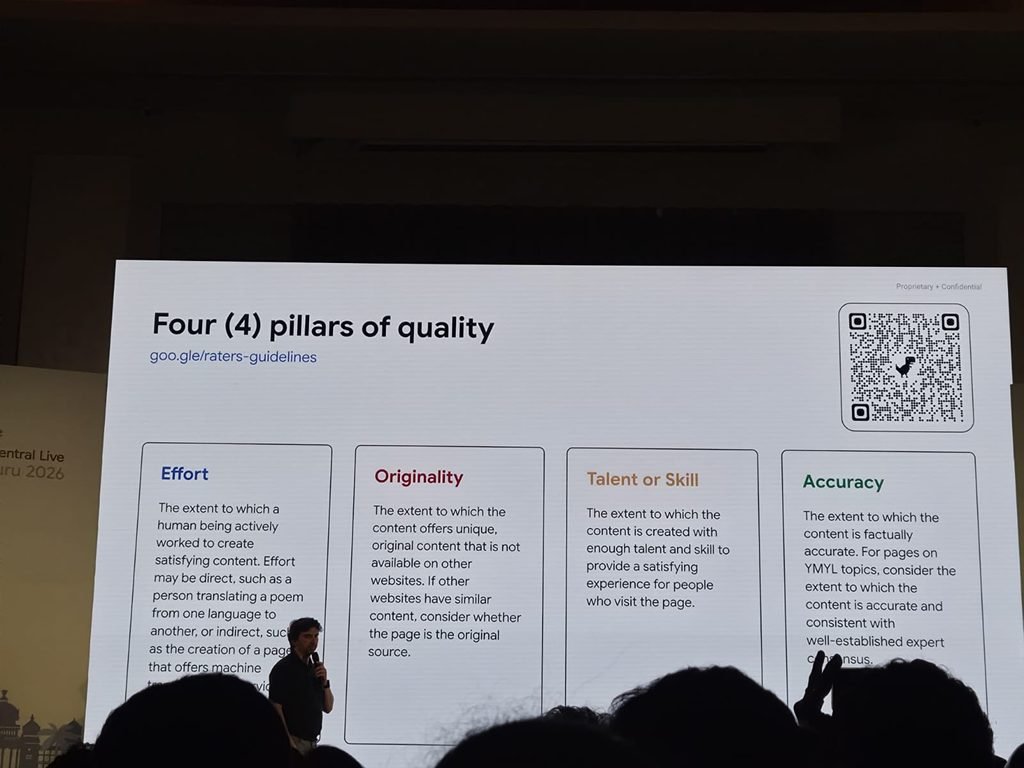
Google emphasised the importance of effort, originality, skill and accuracy in content.
There is a clear difference between generic content that repeats information already available online and original content that offers first-hand experience, expert insights or unique research.
Another important reminder was the scale of web spam. According to one presentation slide, Google identifies approximately 40 billion spammy pages every day.
Spammy pages can be deprioritised during crawling and demoted or filtered during indexing.
The takeaway is simple: producing more content doesn’t necessarily mean producing better content. Originality, accuracy and trust matter.
Watch out
Google identifies approximately 40 billion spammy pages every day and deprioritises them during crawling and indexing. Publishing more content is not the answer. Publishing content that offers something genuinely different like first-hand experience, original research, or expert depth is important.
6. Google continuously tests and improves Search
Google shared its 2023 Search experimentation figures:
- 719,326 search quality tests.
- 124,942 side-by-side experiments.
- 16,871 live traffic experiments.
- 4,781 launches.
These historical figures demonstrate the scale of testing behind Google Search.
Another clarification: quality raters do not directly improve or reduce individual website rankings. Their feedback helps Google evaluate its search systems.
For SEO professionals, the lesson is to understand the fundamentals rather than react to every ranking fluctuation or industry rumour.
7. The value of connecting with the SEO community
Beyond the technical sessions, one of the most valuable parts of attending was meeting other SEO professionals.
Exchanging ideas about how different teams are using AI, measuring AI visibility and improving their workflows offered perspectives beyond the presentations.
It was interesting to understand how professionals are approaching similar challenges in different ways.
These conversations reinforced that staying relevant in SEO is not just about learning new tools. It is also about sharing experiences, questioning assumptions and learning from the wider industry.
Final thoughts: The future of SEO is about adapting
Google Search Central Live Bengaluru 2026 reinforced one important lesson: SEO is not dead. It is evolving.
AI is changing how people search and how information is presented. Google Discover is creating additional opportunities for content discovery, while internationalisation and technical SEO remain important for reaching the right audiences.
But the foundations of search visibility remain familiar:
- Strong technical SEO.
- Useful and original content.
- Relevance and search intent.
- Experience and expertise.
- Trust and quality.
The biggest opportunity is to adapt to changing search behaviour without losing sight of these fundamentals.
The tools may change, and search experiences may look very different in the coming years. But creating content that genuinely helps people remains the best place to start.
Good SEO is good GEO. And SEO is far from dead.
Saranya is an SEO professional specialising in technical SEO, organic growth, and search strategy. She has experience driving organic performance through technical audits, website optimisation, content strategy, and data-driven SEO initiatives across platforms like Groww and redBus.
You can reach Saranya at: https://www.linkedin.com/in/saranya96