
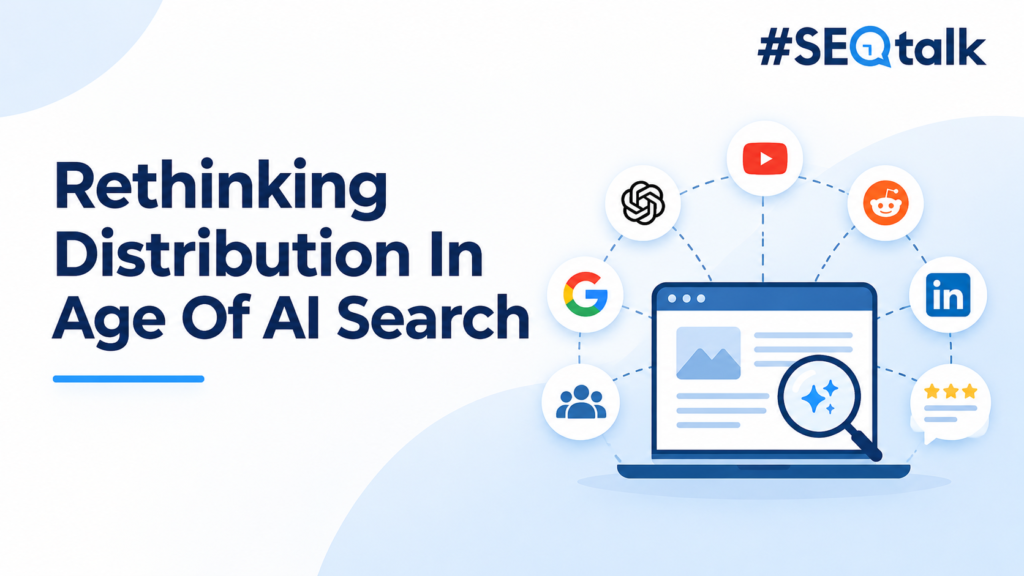
Here is a thought experiment the SEOTalk community opened Episode 146 with: if Google disappeared tomorrow, would anyone find your brand?
It sounds dramatic. It is less hypothetical than it sounds.
Seventy percent of Google searches in the US now end without a click. AI overviews appear in roughly 40% of US desktop searches. And yet search volume itself is up 8% over the last two years. People have not stopped searching. They have stopped clicking through.
What that means is that AI surfaces, not links, are now handling the handoff between a question and an answer. ChatGPT, Perplexity, Gemini, and Claude read what the web says about your brand across YouTube, Reddit, LinkedIn, review sites, and newsletters. They synthesise it and hand the answer directly to your audience.
Your content still matters. But where it lives, who publishes it, and which platforms amplify it now determines whether it gets found at all.
That is a distribution problem. And according to Orbit Media’s annual blogger survey, it is one most marketers have not solved. Only 14% of marketers said their blogs delivered strong results in their most recent survey. Four years ago, that figure was double. The content did not get worse. The distribution model did not keep up.
That is what Episode 146 of SEOTalk Spaces was about.
Key Takeaways
- Search volume is growing but clicks are falling. The problem is distribution, not content quality.
- SEOs are best placed to map which platforms AI engines cite, but they should not execute distribution alone.
- Different AI engines pull from different platforms. YouTube appears more in Perplexity and Gemini. Reddit shows up more in ChatGPT.
- Repurposing content still works, but only if the content is properly adapted per platform, not copy-pasted.
- Personal experience content and question-led formats are the types most likely to get cited by AI engines.
The Era of Publish and Wait Is Over
For most of the last decade, the SEO playbook had a clear sequence: produce good content, build authority, rank, and collect traffic. It was slow, but it worked. Ranking was the goal because ranking meant clicks meant revenue.
That sequence has broken down. Not because Google is gone, but because the click is no longer guaranteed even when you rank.
Parth Suba put it plainly during the session: ranking should now be the last step of a strategy, not the primary goal. Discovery comes first. The question is no longer how to rank for a keyword. It is where your content should live and who else should be saying it.
The Orbit Media data puts a number on the gap. Blog traffic has halved over the last four years as AI adoption reached close to 90% in the US. That is not a content quality problem. The same writers, the same topics, the same effort. The issue is that the content is sitting on a website waiting for a click that is increasingly going to an AI-generated answer instead.
The implication is uncomfortable but useful: publishing without a distribution plan is no longer a slow strategy. In 2026, it is close to invisible.
Framework 1: SEO as the Operating System of Marketing
One of the more clarifying ideas to come out of the episode was how to think about the SEO function in a world where distribution is fragmented across dozens of surfaces.
Suchi framed it this way: the SEO person should function as the operating system of the marketing team. Not the person executing every distribution channel, but the person providing the intelligence that makes distribution decisions better. Research, competitive analysis, platform fit, audience mapping, content format recommendations. SEO generates the input. Social, PR, and content teams act on it.
This matters because the signals AI surfaces rely on no longer live only on the brand website. They live on Reddit threads, LinkedIn articles, YouTube videos, newsletters, Quora answers, and niche community forums. An SEO is well placed to identify which of those surfaces are being cited for a given topic, in a given industry, by a given AI engine. That is fundamentally a research and mapping task, which is exactly what SEOs are trained to do.
The execution, however, should be distributed across teams. As Suchi noted, SEOs cannot and should not execute everything. Social media managers understand platform culture. PR teams have the relationships. The operating system model means SEO coordinates and informs rather than owns every output.
There was one point of productive disagreement on this in the session. Aniruddh argued that digital PR should remain a separate specialisation rather than folding into the SEO brief. His reasoning was that dedicated PR professionals bring capabilities that SEOs do not typically develop, and mixing responsibilities risks diluting both. It is a fair line to draw. The operating system model does not require SEO to absorb everything. It requires SEO to have visibility into everything.
Ryan added a practical dimension: whether SEOs want the responsibility or not, they tend to pick it up. If you are tracking analytics, you can see which distribution channels are working and which are not. That visibility creates accountability. His advice was straightforward: if you are taking on distribution strategy, make sure your pricing reflects it.
What to do with this
Framework 2: The Platform-to-AI-Surface Map
Not all AI engines draw from the same sources. This was one of the most practical observations in the session, and it has direct implications for where brands should focus their distribution effort.
Based on what the panel has observed across client work and their own experiments, the picture looks roughly like this:
- YouTube appears more prominently in Perplexity, Google AI Mode, and Gemini responses
- Reddit is more frequently cited in ChatGPT responses
- LinkedIn performs well for B2B brands across multiple AI surfaces, particularly when combined with YouTube Shorts
The practical implication is that distribution strategy should start with a question: which AI engine is my audience most likely to use? A B2B SaaS brand whose buyers use Perplexity heavily should be thinking seriously about YouTube content. A consumer brand with an audience on ChatGPT should be investing in Reddit presence and understanding how that community operates.
Parth’s recommendation was to measure visibility and citation across AI surfaces separately rather than tracking them as a single aggregate number. GA4 now reports direct and referral traffic from AI sources. Google Search Console has added functionality to connect social profiles. The data is available. Most brands are not using it yet.
A note on small businesses
One audience member asked a question that comes up constantly: for a small business that relies on lead generation through search, should SEO still be the primary focus?
Parth’s answer was direct and worth quoting closely. He would not recommend SEO as the starting channel for a bootstrapped business in 2026. The zero-click nature of search makes it difficult to demonstrate ROI inside three months. Building topical authority and domain authority takes time that an early-stage business often cannot afford.
The better starting approach is to identify which marketing channel can generate measurable return from month two. That might be WhatsApp marketing, Meta ads, email, influencer partnerships, or shopping ads, depending on the category. Once revenue is coming in through a faster channel, SEO compounds on top of it. The mistake is treating SEO as free marketing when it has always required investment in content, links, and technical work, and that investment takes longer to pay off than it once did.
Watch out for this
Framework 3: The Attention Trifecta
Ryan brought a framework to the session that is deceptively simple and applies across every platform: the trifecta.
His starting point was that every platform algorithm, regardless of format or audience, runs on a single directive. Keep the user on the platform for as long as possible. If you can answer how to do that for a specific platform, you do not need to be a social media expert. You need to be a marketer.
The trifecta is his method for doing it on video-first platforms, specifically YouTube and X, though the principle generalises.
The three elements:
- Thumbnail (the visual first impression)
- Title (the written promise)
- Opening seconds of the video (the immediate payoff)
All three must match. Not thematically. Literally. The thumbnail shows something. The title describes it in words. The first few seconds of the video confirm both. When those three elements are consistent, the viewer is subconsciously validated before they have invested any real time. That reduces the bounce, increases watch time, and signals quality to the algorithm.
Ryan described navigating a platform as the consumer before switching to the creator lens. He runs two accounts for client work: one to scroll as the target audience, one to create as the brand. The gap between what the consumer experiences and what the brand thinks they are delivering is usually where the distribution problem lives.
The same logic applies to written content. A headline makes a promise. The opening paragraph must immediately honour it. The structure must follow through. When all three are consistent, readers stay. When the headline over-promises and the content under-delivers, they leave. Platforms read that signal and reduce distribution.
What to do with this
Is Repurposing Still Worth It?
Repurposing content across platforms has been a staple distribution advice for years. The question the panel debated was whether it still holds in 2026 or whether it has become a shortcut that produces mediocre results everywhere.
The answer the panel landed on: repurposing is still a strong strategy. But it has a condition.
Parth’s framing was clear. The same core idea can and should travel across platforms. What cannot travel unchanged is the format, the hook, the funnel path, and the voice. Instagram, LinkedIn, Reddit, YouTube, and email all have different algorithms, different audiences, different attention spans, and different ways of moving a reader toward an action. A LinkedIn article does not convert on Instagram. A Reddit comment that feels promotional gets flagged by the community. A YouTube intro that works on a ten-minute video does not work on a sixty-second Short.
There is also a more fundamental condition. Parth noted that repurposed content only works consistently if it is posted as a real person representing the brand, not as a faceless brand account. The personal presence is what builds the trust that makes repurposing land. Without that, distributing the same content widely just means publishing to multiple audiences that do not know who is behind it.
Ryan’s observation about Reddit is worth highlighting separately. Getting distribution right on Reddit requires understanding the community’s deep sensitivity to anything that feels like advertising. The community has effectively built its own immune system against promotional content. Getting it wrong does not just fail to reach the audience. It can damage the brand’s standing in that community permanently.
Why the Brand Website Still Matters
The panel spent time on a question that surfaces regularly in the community: if AI engines pull from third-party sources, do brands still need their own websites?
The answer is yes, but the reason has shifted.
The website is still the source of truth. It may no longer be the centre of influence. Those are two different things, and conflating them is where brands make mistakes.
Parth drew on research by Rand Fishkin to explain this. When clear, correct, and branded information lives on the brand’s own website, AI models are more likely to attribute claims to the right source. When a brand’s own site is thin on product detail, comparison data, or specific claims, that space gets filled by third-party bloggers, YouTube reviewers, or affiliate sites. For a SaaS company with an affiliate program, that means a competitor’s affiliate or a review site with outdated information is shaping how AI engines describe the product.
The website is also still where most revenue actually converts, as Vedant noted. Despite all the fragmentation, the majority of commercial outcomes still flow through Google search and the brand website. That is worth protecting even while building presence elsewhere.
Ryan’s point was about trust rather than traffic. For personal brands and freelancers, the website is a portfolio and a signal that a real person is behind the work. In a landscape where AI-generated content is everywhere, showing a real face, a real story, and real evidence of past work does something that no amount of off-site distribution can fully replace.
What Content Actually Gets Cited
If distribution is about getting content in the right places, the question that follows is: what type of content actually gets picked up and cited by AI engines?
The panel pointed to a consistent answer: personal experience, written in the first person, structured to answer specific questions.
Ryan has been running a live experiment through his mother’s quilt shop for the past year. One blog post, written from genuine first-hand experience about how to care for a memory quilt, has continued to drive traffic and conversions consistently. The post works not because it covers a popular keyword but because it was written by someone who actually knows the subject and answers the questions a real buyer would ask.
The second experiment from the same site is more immediately actionable. Ryan rewrote the product descriptions for a range of new trousers as questions rather than statements. He added FAQ sections to each product page. Within two months, those products were selling significantly better. The reason is straightforward: searches are becoming more conversational. Voice queries and agent-driven queries are full sentences or questions. Content written in question-and-answer format matches that query pattern more closely than a list of product features does.
Suchi connected this to a broader shift in how people search. The keyword era rewarded content that matched a phrase. The conversational era rewards content that answers an intent. Those are different writing tasks. The first is about placement. The second is about understanding.
The practical test
What to Do This Week
The frameworks from this session are not long-term strategic initiatives. Most of them can be tested immediately.
Five actions worth taking before the next session:
- Audit your off-site presence. Search your brand name on ChatGPT, Perplexity, and Gemini. Note which sources they cite. That is your current distribution footprint as AI engines see it. Identify what is missing.
- Map your platforms to AI surfaces. Based on the platform-surface observations from the panel, identify which AI engine your target audience uses most. Check whether your content is present on the platforms that engine draws from.
- Apply the trifecta to one piece of content. Pick a recent article, video, or social post. Check whether the headline or thumbnail, the opening, and the structure all honour the same promise. Align them if they do not.
- Rewrite three product or service descriptions as questions. Add a FAQ block. This is a low-effort test with measurable outcomes. Ryan’s experiment is a reproducible template.
- If you are advising an SMB, audit their fastest channel first. Before recommending SEO, understand where revenue is currently coming in. Build the SEO layer on top of a channel that is already working.
Frequently Asked Questions
Is SEO dead now that AI search handles so many queries?
No, but the goal of SEO has changed. Search volume is still growing. What is falling is the click-through rate, not the search itself. The job now is to ensure your brand is present across the surfaces AI engines read when forming their answers, not just to rank a page at position one.
The panel landed on a middle position: SEOs should be responsible for the strategy and intelligence behind distribution decisions, not the execution of every channel. Identifying which platforms AI engines cite for a given topic is SEO research. Posting on those platforms is execution that social and PR teams are better placed to handle.
Which platforms should I focus on if I want my brand to show up in AI search results?
Based on the panel’s observations: YouTube is cited more frequently in Perplexity, Google AI Mode, and Gemini. Reddit appears more often in ChatGPT responses. LinkedIn is effective for B2B brands across multiple AI surfaces. The right answer depends on which AI engine your audience uses most, so start there.
Is repurposing content across platforms still a good strategy in 2026?
Yes, with one condition: the content must be adapted for each platform, not simply copied. Different platforms have different algorithms, audiences, and attention patterns. The same core idea can travel, but the format, hook, and funnel path need to be rebuilt for each destination.
If most of my clients are small businesses, should I still be recommending SEO as a starting channel?
Not necessarily as the first channel. Zero-click search makes it difficult for a bootstrapped business to show SEO ROI inside three months. A faster-return channel (email, paid social, WhatsApp, shopping ads) should come first. SEO compounds well on top of an already-working channel.
What type of content is most likely to get cited by AI engines like ChatGPT or Perplexity?
Personal experience content written in the first person, structured to answer specific questions in natural language. Generic guides and keyword-stuffed articles are easy for AI engines to skip over because there are hundreds of similar alternatives. First-hand experience is harder to replicate and more likely to be cited as a distinctive source.
Check the recap of the podcast